THE MOST HAUNTING MOMENT IN THE HISTORY OF LIVE TELEVISION IN HORSE RACING
On the afternoon of May 3, 2008, Churchill Downs in Louisville, Kentucky, pulsed with the electric energy that only the Kentucky Derby can generate. More than 157,000 spectators packed the grandstands under brilliant spring sunshine, while an estimated 20 million viewers tuned in to NBC’s national broadcast. The 134th running of America’s greatest horse race promised drama: a field of twenty talented three-year-olds, a heavy favorite in Big Brown, and one lone filly daring to challenge the colts. That filly was Eight Belles, a striking gray-roan daughter of Unbridled’s Song out of the mare Away.
She arrived at the Derby with an undefeated spring campaign that included dominant victories in the Martha Washington Stakes by thirteen and a half lengths, the Honeybee Stakes, and the Fantasy Stakes—performances that had made her a fan favorite and the first filly in Oaklawn Park history to sweep those three races.
Eight Belles carried the hopes of her connections—trainer Larry Jones, jockey Gabriel Saez, and owner Fox Hill Farms—into the starting gate at post position five. She broke alertly and settled into a perfect stalking position behind the early leaders. As the field swung into the long Churchill Downs stretch, she unleashed a powerful closing kick that carried her past most of the colts. When the wire flashed overhead, she had secured a clear second-place finish, beaten only four and three-quarters lengths by the impressive Big Brown. For a fleeting moment, the crowd roared its approval.
The filly had run the race of her life with ears pricked and heart on full display.
Then, in the space of a few strides, everything changed.
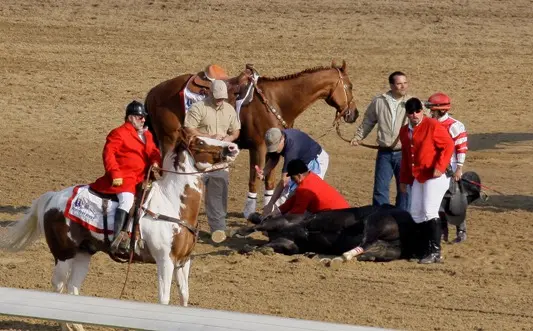
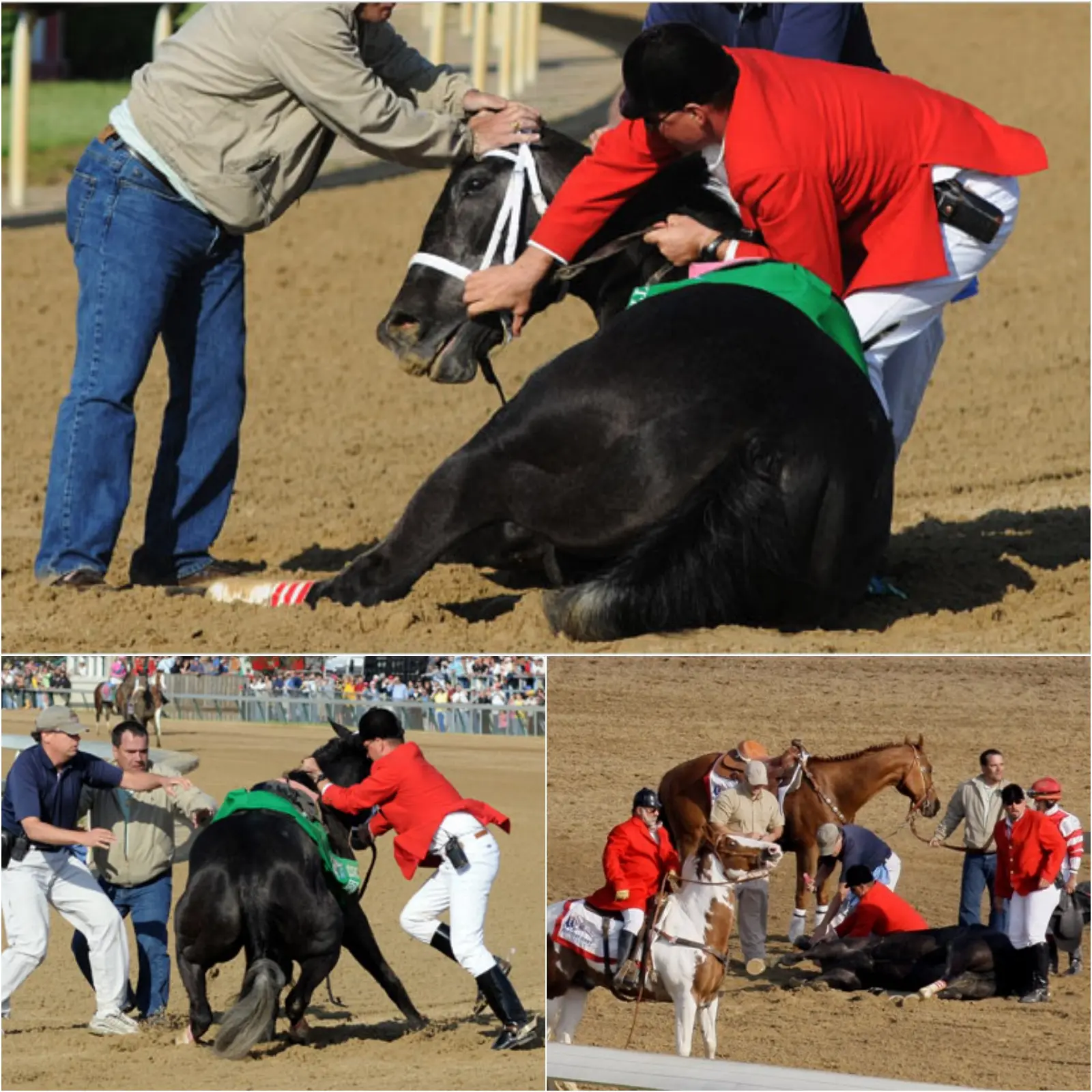
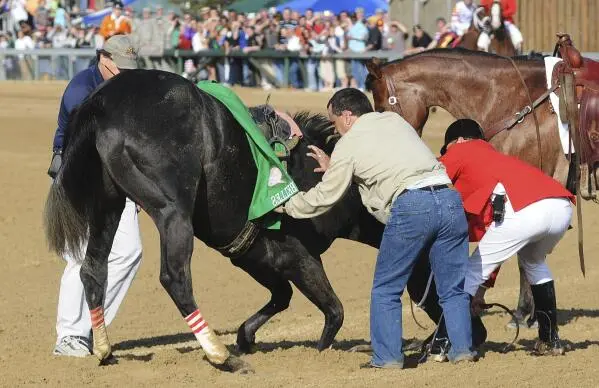
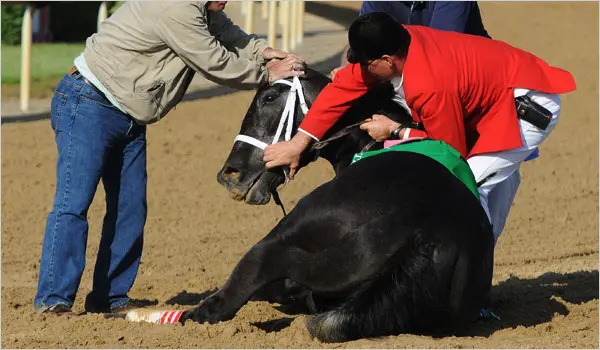
As Eight Belles began to pull up after crossing the finish line and galloped toward the clubhouse turn, her front legs suddenly gave way. Both cannon bones and sesamoid bones in her lower forelegs fractured in catastrophic compound breaks. The elegant gray filly, who moments earlier had looked invincible, collapsed onto the dirt track in full view of the television cameras. Millions watching at home witnessed the horror unfold in real time—no replay, no editing, no buffer. Saez, who had felt something amiss immediately after the wire, jumped from the saddle and knelt beside his mount. Track veterinarians, including Dr.
Larry Bramlage, rushed to the scene. One look at the injuries confirmed the unthinkable: the damage was so severe that moving her was impossible and any attempt at treatment offered no realistic chance of survival or even a pain-free existence. With quiet professionalism and profound sadness, the veterinarians administered a lethal injection on the spot. Eight Belles, only three years old, was humanely euthanized where she fell.
The silence that followed was deafening. In the stands, grown men and women wept openly. On the broadcast, commentators struggled for words. Across living rooms and sports bars nationwide, viewers sat stunned, many in tears. The image of that beautiful, courageous filly lying motionless on the hallowed Churchill Downs dirt became seared into the collective memory of American sports. It was not merely a racing accident; it was a public tragedy played out live on national television, raw and unfiltered.
The aftermath was immediate and intense. PETA protesters gathered outside racing offices. Columnists and talk-show hosts demanded answers. Questions flew about breeding practices, medication, track surfaces, and the wisdom of running fillies against colts in the world’s most demanding race. Eight Belles’ pedigree came under particular scrutiny. She carried multiple crosses to Raise a Native, a line known for brilliance but also for unsoundness in the ankles—the very area that failed her. Breeding expert Ellen Parker had quietly voiced concern the night before the race, noting the filly’s genetic vulnerabilities.
Trainer Larry Jones, devastated yet composed, insisted it was a tragic accident, pointing out that Eight Belles had passed every pre-race examination with flying colors and had never shown lameness in training. Necropsy results later confirmed the bilateral fractures, with no evidence of drugs or foul play. Jones noted that she had always been a bit clumsy when pulling up, a trait that contributed to her lightning speed but also to her vulnerability.
The racing industry could not ignore the moment. Eight Belles’ death, coming just two years after Barbaro’s catastrophic injury in the Preakness, forced a reckoning. Within months, anabolic steroids were banned from racing. The Jockey Club accelerated development of the Equine Injury Database to track fatalities systematically. Tracks began implementing stricter pre-race veterinary protocols, improved surface maintenance, and padded riding crops. Jockeys at the subsequent Preakness Stakes wore special stickers honoring Eight Belles.
In September 2008 she was laid to rest in the garden of the Kentucky Derby Museum at Churchill Downs, and the following year the track inaugurated the Grade II Eight Belles Stakes on Derby Day as a lasting tribute.
Nearly two decades later, the memory of that afternoon remains haunting precisely because it was witnessed by so many in real time. It stripped away the glamour of the Derby and exposed the inherent risks of a sport where magnificent animals push their bodies to the absolute limit. Yet from that darkness came meaningful progress. The Horseracing Integrity and Safety Authority (HISA), building on reforms sparked by tragedies like Eight Belles and Barbaro, has delivered sustained improvements.
In 2025, tracks operating under HISA recorded 1.04 racing-related equine fatalities per 1,000 starts—a nearly fifty percent decline since national tracking began in 2009 and a figure that means almost 99.9 percent of all starts concluded without loss of life. While a slight uptick from the record low of 0.90 in 2024 and higher rates at certain venues like Churchill Downs itself remind everyone that vigilance must never waver, the trajectory is clear: the sport is measurably safer today than it was when Eight Belles ran her final race.
Still, no statistic can erase the visceral impact of that live broadcast. For those who watched, the sight of Eight Belles—ears forward, running with pure joy one moment, then broken and still the next—embodies both the breathtaking beauty and the heartbreaking fragility of Thoroughbred racing. She did not die in vain. Her courage on the track and the industry’s response in the years since have saved countless other horses from similar fates. Larry Jones often speaks of the photo he keeps of her nearing the finish line, ears up and happy.
That image, and the one that followed so cruelly, together tell the full story of a filly who gave everything and, in doing so, changed the conversation about how we care for these extraordinary athletes.
Eight Belles ran into history on that first Saturday in May 2008. The moment she fell will forever stand as one of the most haunting in the long chronicle of live television sports—not because of sensationalism, but because it forced millions to confront the price sometimes paid for greatness. Her legacy endures in every safety reform, every improved protocol, and every young horse that now benefits from a sport that learned hard lessons from her final strides. She was, and remains, a symbol of grace under pressure and the enduring spirit of the Thoroughbred.