The 457 yards Matthew Stafford threw in Week 16 did not arrive with fireworks, choreographed celebrations, or a sense of spectacle. They arrived the way most of his defining moments have: efficiently, almost quietly, embedded within the flow of a long career that rarely demanded attention but always earned it.
Stafford’s stat line that night felt less like an announcement and more like a confirmation. Eleven career games of 400 passing yards or more place him inside the top five in NFL history, alongside names whose careers were wrapped in myth, marketing, and constant debate.
Yet Stafford’s presence in that group feels different. His achievements do not come with an aura of self-promotion or carefully constructed narratives. They come from accumulation, from years of absorbing hits, learning systems, and throwing into windows that most quarterbacks never attempt.
From the beginning, Stafford was never framed as a savior in the romantic sense. Drafted first overall by Detroit, he inherited a franchise defined by instability rather than glory. What followed was not a dramatic transformation but a steady, grinding partnership between quarterback and circumstance.
In Detroit, Stafford learned how to survive Sundays that offered little margin for error. His arm talent was obvious early, but his legacy there was shaped more by endurance than dominance. He threw often, threw hard, and threw under pressure, both literal and organizational.
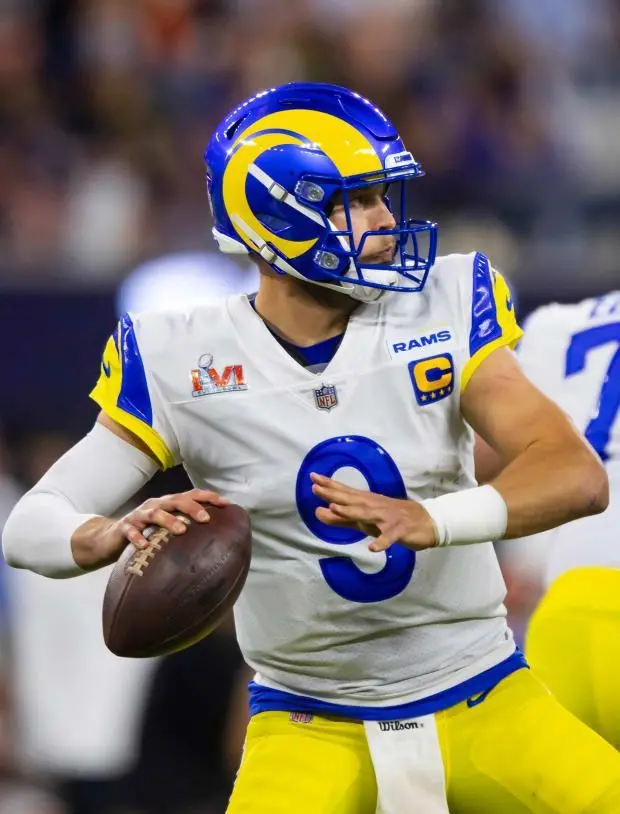
The 400-yard games began stacking up almost as a byproduct of necessity. Detroit needed Stafford to throw, and he obliged without complaint. There was no mystique to it. He lined up, read the defense, and trusted his arm to handle the rest.
Those performances rarely shifted the national conversation around him. They were impressive, but not transformative. Wins did not always follow, and accolades remained scarce. Still, the tape told a consistent story: Stafford could move the ball against anyone, anytime.
When he eventually left Detroit, there was no victory lap. The trade to Los Angeles felt practical, even overdue. For Stafford, it represented not a reinvention but a relocation, carrying the same habits into a more functional environment.
The Super Bowl win that followed with the Rams briefly placed him in the spotlight. Yet even then, the narrative centered on the roster, the defense, the moment. Stafford’s role was acknowledged, respected, then quickly folded into the larger story of team success.
What Week 16 represented was not redemption or validation. It was continuity. At 457 yards, the performance mirrored dozens of others across his career, differing only in context and consequence. The throws were sharp, the reads decisive, the demeanor unchanged.
Reaching eleven 400-yard games does not speak to peak brilliance as much as sustained capability. It reflects a quarterback trusted to carry volume, responsibility, and risk over many seasons, across multiple offensive philosophies, without dramatic decline in effectiveness.
Stafford’s style has never been ornamental. His throws are often violent, direct, stripped of unnecessary flair. He is willing to test safeties, challenge corners, and accept interceptions as part of the equation rather than as personal failures.

That mentality has both helped and hurt his reputation. He has been labeled reckless, underrated, overpaid, underappreciated, sometimes all at once. Rarely has he been framed as inevitable, even as his numbers quietly argue otherwise.
The list he joined with that eleventh 400-yard game is populated by quarterbacks who defined eras. Stafford did not define an era. Instead, he endured through several, adapting without becoming emblematic of any single one.
That may be why his career resists simple categorization. He was never the league’s moral center, its revolutionary thinker, or its cultural symbol. He was, more often than not, its reliable engine, running regardless of external noise.
Week 16 felt like a reminder that consistency itself can be historic. In a league obsessed with peaks, valleys, and viral moments, Stafford’s career suggests another path: durability paired with competence, ambition without spectacle.
Even now, discussions around Stafford tend to be framed in hypotheticals. What if he had more support earlier? What if he avoided injuries? What if timing aligned differently? The 457-yard night offered no answers, only evidence.
It showed a quarterback still capable of reading the field quickly, trusting receivers, and delivering with precision when the game demands volume. It showed instincts that have not dulled, even as the body absorbs years of punishment.
The Rams did not design that game to showcase Stafford. Circumstances required him to throw, and he did. That pattern has repeated throughout his career, making his statistical milestones feel earned rather than engineered.

NFL history often remembers characters more vividly than contributors. Stafford’s challenge will be resisting that gravitational pull toward obscurity. Yet records like eleven 400-yard games serve as anchors, keeping his name tethered to the league’s factual memory.
There is something fitting about Stafford reaching the top five without ceremony. No grand declaration followed. No self-authored legacy speech emerged. The number simply updated, and the league moved on, as it usually does.
But history does not forget numbers easily. They linger, inviting future comparisons, forcing context upon discussions that once dismissed him as merely good. Over time, accumulation becomes argument.
The 457 yards were not a climax. They were a chapter. Another entry in a career built not on moments designed for highlight reels, but on repetition, resilience, and an unspoken agreement with the game to keep showing up prepared.
Matthew Stafford’s place in NFL history may never be universally celebrated, but it is increasingly difficult to ignore. His milestones arrive without noise, yet they demand recognition all the same.
In that way, the Week 16 performance felt perfectly aligned with who he has always been: a quarterback uninterested in spectacle, but committed enough to consistency that the record books had no choice but to make room for him.