THE WORLD’S BIGGEST MYSTERY OF THE DISAPPEARANCE OF LEGENDARY SHERGAR
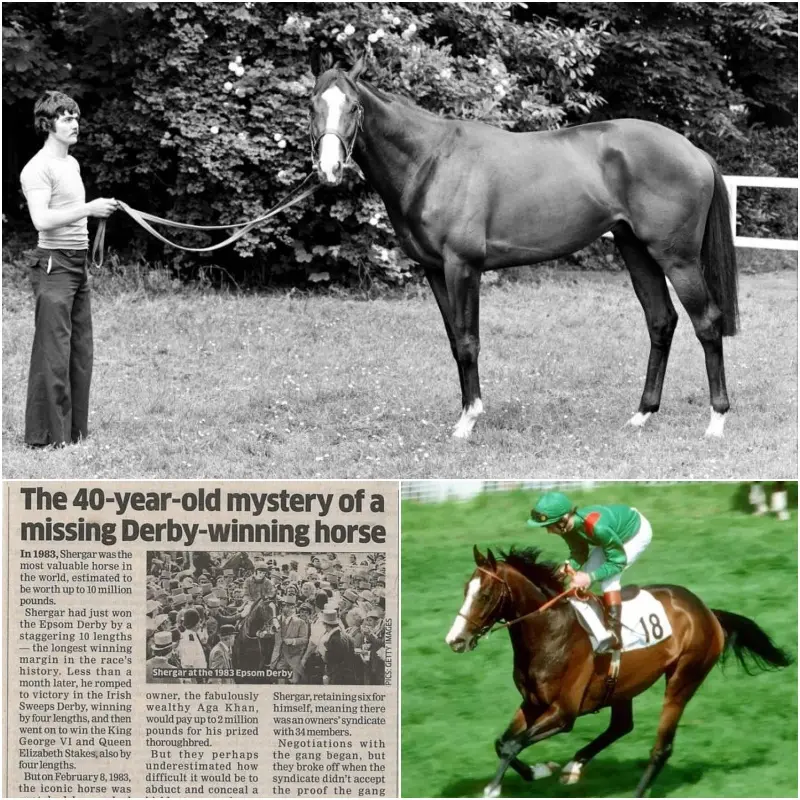
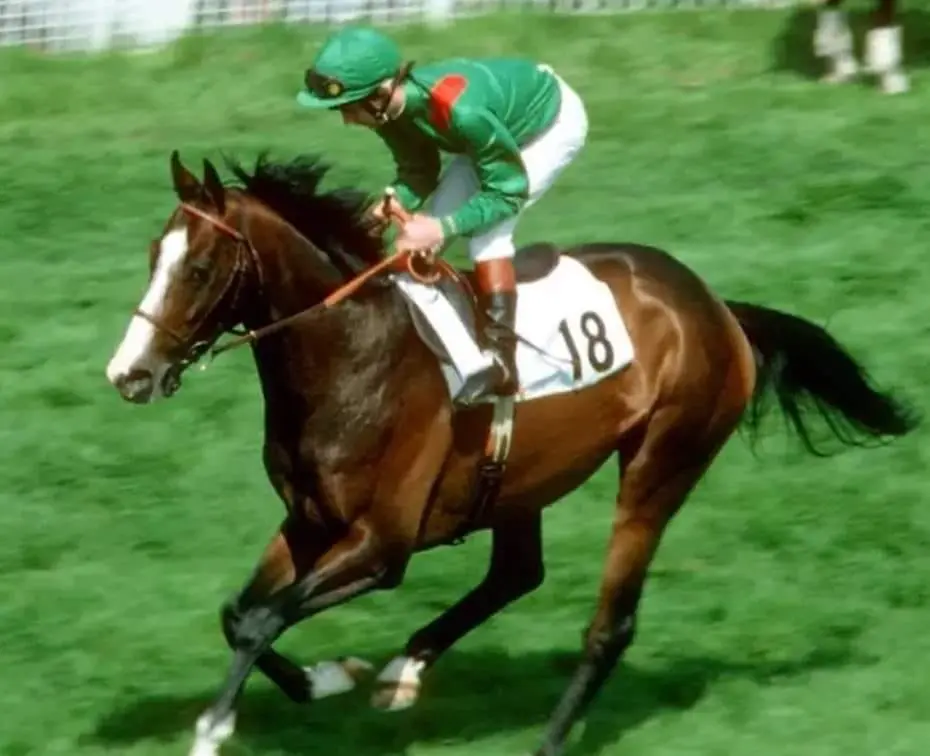
Shergar was more than a racehorse; he was a symbol of excellence and national pride for Ireland and the racing world. Born in 1978 at the Aga Khan’s Ballymany Stud in County Kildare, the bay colt quickly rose to legendary status. Trained by the renowned Michael Stoute in England, Shergar displayed extraordinary talent from an early age. In 1981, as a three-year-old, he dominated the Epsom Derby, winning by a record-breaking 10 lengths under jockey Walter Swinburn.
This margin remains one of the most emphatic victories in the race’s storied history, earning him the nickname “the greatest horse of his generation.” He followed up with wins in the Irish Derby and the King George VI and Queen Elizabeth Stakes, cementing his reputation as an unbeatable force on the turf.
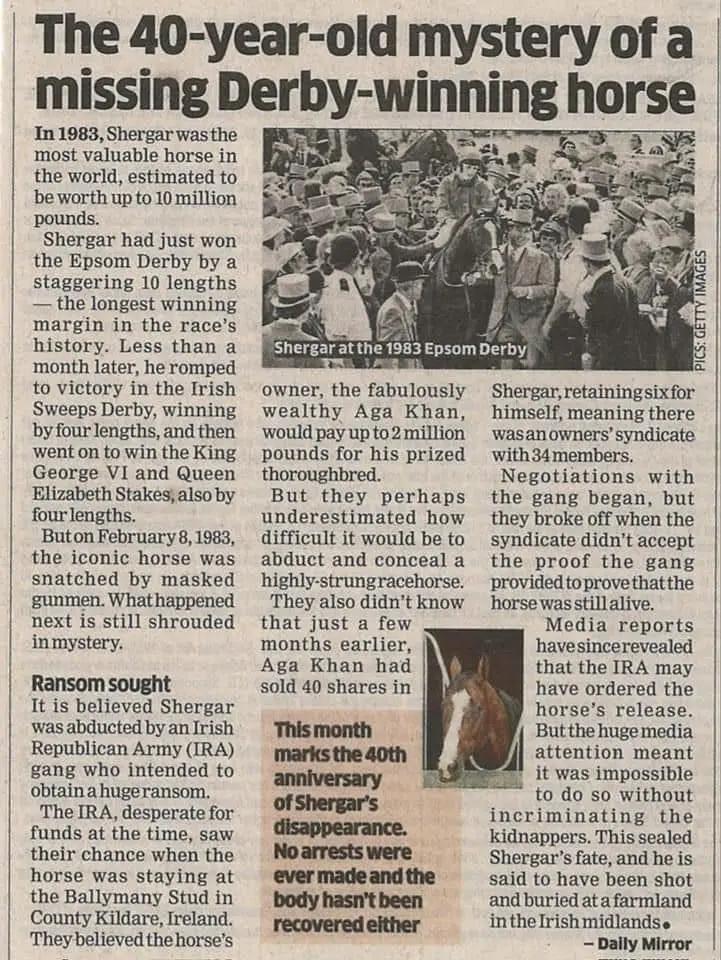
At the end of his racing career, Shergar retired to stud duties at Ballymany, where his services commanded a staggering fee of around £100,000 per mare. Syndicated among 40 shareholders, including the Aga Khan who retained a portion, the horse was valued at millions, with estimates placing his worth as high as £10 million. He represented not just financial investment but also prestige in the thoroughbred breeding industry. Yet, this glittering success was tragically cut short in one of the most audacious crimes in sporting history.
On the foggy night of February 8, 1983, a group of masked gunmen stormed Ballymany Stud. Armed with machine guns, they overpowered the night watch and forced head groom Jim Fitzgerald, at gunpoint, to lead them to Shergar’s stable. Fitzgerald was made to load the stallion into a horsebox, after which he was driven around for hours in a disorienting journey before being released unharmed near a remote location. By the time authorities were alerted—delayed by several hours due to the trauma and confusion—the horse was long gone.
No immediate ransom note appeared, but soon afterward, the kidnappers contacted intermediaries demanding £2 million for Shergar’s safe return.
Negotiations unfolded chaotically. The syndicate of owners, advised by security experts, refused to pay, fearing it would encourage further thefts in the valuable world of horse racing. The kidnappers provided proof of life in the form of Polaroid photographs showing Shergar’s head next to a newspaper dated February 11, but these were deemed insufficient by the owners, who suspected the images might have been taken earlier or manipulated. Contact eventually ceased, with one chilling call reportedly warning that the horse would be killed if demands were not met. No ransom was ever paid, and Shergar vanished without a trace.
From the outset, suspicion fell heavily on the Provisional Irish Republican Army (IRA). The kidnapping occurred during the height of The Troubles, a period of intense conflict in Northern Ireland. The IRA, known for fundraising through various means to support their armed campaign, was believed to have targeted Shergar as a high-profile, lucrative target. The Aga Khan, a prominent international figure with no direct political ties to the conflict, was seen as someone likely to pay without escalating tensions. Despite initial denials from the IRA, the theory gained traction over the years.
The most detailed account came in 1999 from Sean O’Callaghan, a former IRA member turned informant. In his book “The Informer,” O’Callaghan claimed the operation was authorized by senior IRA figure Kevin Mallon. He described it as a botched plan: the kidnappers, inexperienced with handling a highly strung thoroughbred stallion, struggled to control Shergar during transport. The horse reportedly panicked, injuring his leg severely—possibly fracturing a bone. Faced with an animal in distress and lacking veterinary expertise, the gang allegedly shot Shergar to end his suffering and eliminate evidence.
According to O’Callaghan, the killing happened within hours or a day of the abduction, and the body was disposed of, possibly buried in a remote bog or pit near Ballinamore in County Leitrim, close to the border region.
This narrative has been echoed in various reports and books, including investigations by The Sunday Telegraph and The Observer. Some sources suggest the remains were left in the countryside around Aughnasheelin, but extensive searches over the decades have yielded nothing conclusive. In 2000, a skull with bullet holes was discovered in County Kerry, sparking brief speculation, but DNA testing ruled it out as Shergar’s. No other credible evidence of the remains has surfaced.
The crime shocked the racing community and made global headlines, inspiring documentaries, books, and even fictionalized accounts. It highlighted vulnerabilities in the security of valuable bloodstock operations at the time—Ballymany Stud had minimal protection despite housing one of the world’s most prized animals. The incident also raised questions about insurance payouts; many policies did not fully compensate the syndicate because proof of death was never established, leaving Shergar technically “missing” rather than confirmed deceased.
More than four decades later, the mystery endures. Recent reflections, including articles following the death of the Aga Khan in February 2025 at age 88, have revisited the case, underscoring how the disappearance remains unsolved. No arrests were ever made, and the IRA never officially claimed responsibility. While O’Callaghan’s account is widely regarded as the most plausible explanation, it has never been independently verified or substantiated with physical proof. Theories of involvement by criminal syndicates, rogue gamblers, or even internal disputes have circulated but lack supporting evidence compared to the IRA link.
Shergar’s story is a haunting blend of triumph and tragedy. A horse that captivated millions with his dominance on the track became an enduring enigma off it. His record-breaking Derby win lives on in racing lore, but the unanswered questions—Who exactly ordered the theft? Why did the plan fail so catastrophically? Where do his remains lie?—keep the legend alive. In an era of advanced forensics and cold-case reviews, Shergar’s fate stands as one of sport’s greatest unsolved mysteries, a reminder that some shadows refuse to lift even after all these years.