The Los Angeles Rams understood immediately that replacing Aaron Donald was never going to be about finding a successor with comparable accolades. You do not substitute a once-in-a-generation force. You either chase ghosts, or you redefine yourself entirely.
Their choice was subtle but radical. Instead of searching for a single dominant name, the Rams opted to reshape the logic of their defense. That process did not begin in Los Angeles, but quietly traced back to Tallahassee.
Florida State became an unlikely foundation for a new Rams identity. Jared Verse and Braden Fiske did not arrive as isolated talents. They arrived as a pair, forged in the same system, fluent in the same terminology, habits, and expectations.
This mattered more than raw measurables. Defensive lines rely on timing, trust, and instinctive reaction. Verse and Fiske did not need months to learn each other’s tendencies. They carried that knowledge with them, already embedded.
Aaron Donald’s greatness often masked complexity. His presence simplified decisions for everyone else. Without him, complexity returned. The Rams’ response was not to simplify again, but to embrace coordination over individual brilliance.

Verse brings violence at the edge, a relentless motor shaped by repetition rather than improvisation. Fiske complements him inside with movement and leverage, understanding spacing not through theory, but through shared experience built over seasons.
Their chemistry is not loud. It does not announce itself through celebration or stat lines. It reveals itself in compressed pockets, disrupted timing, and offenses forced into earlier decisions than planned.
The Rams’ coaching staff recognized this almost immediately. Teaching two rookies separately would have required patience. Teaching two who already spoke the same defensive language allowed acceleration instead.
This approach signals a philosophical shift. Donald commanded attention through singular dominance. The new Rams defense aims to apply pressure through accumulation, waves of disruption rather than one overwhelming point of collapse.
What makes Verse and Fiske intriguing is not just familiarity, but alignment in football upbringing. They learned to read protections similarly, to anticipate slides, to feel blocking schemes develop rather than react late.
That shared memory eliminates hesitation. Where many young defenders pause to confirm reads, these two attack in unison. The milliseconds saved often separate a pressured throw from a clean completion.

This is how defensive identities quietly form. Not through slogans or schemes, but through players who instinctively cover for each other. Verse crashes wide knowing Fiske understands the interior lane he leaves behind.
The Rams did not frame this as rebuilding because rebuilding implies replacement. Instead, they assembled. Each piece was chosen not to mimic Donald, but to interlock with others in predictable, reliable ways.
There is a humility in that decision. It acknowledges that no single player can replicate what Donald did. But it also recognizes that cohesion can produce its own form of intimidation.
Offenses preparing for Los Angeles no longer circle one name repeatedly. They must account for movement, stunts, and pressure points that shift snap to snap, driven by players operating from shared instinct.
Verse and Fiske function as anchors of that system, not because they are flawless, but because they are synchronized. Mistakes are corrected faster when communication is implicit rather than verbal.
This reduces the learning curve for surrounding players. When the interior and edge work in harmony, linebackers play faster, secondaries disguise more confidently, and the entire unit benefits.

It is a quieter evolution than replacing Donald with a headline signing. But it may prove more sustainable. Defensive identity built on synergy tends to age better than identity built on singular greatness.
The Rams’ front office understood the risk. Familiarity does not guarantee NFL success. But it increases the odds that early struggles do not fracture confidence or trust within the unit.
Verse and Fiske have shown flashes that suggest not just potential, but reliability. They do not freelancing for splash plays. They compress space, forcing offenses to operate on narrower margins.
That pressure accumulates over drives. Quarterbacks feel it even when sacks do not materialize. Protection schemes begin to tilt, creating opportunities elsewhere along the line.
This is how a pressing machine forms. Not instantly, and not visibly dramatic. It emerges through repetition, through defenders understanding where help will be without looking.
The Rams are betting that shared memory is more valuable than individual acclimation. That what Verse and Fiske learned together cannot be taught as efficiently through meetings or walkthroughs.
In a league defined by constant turnover, continuity has become a luxury. Los Angeles imported continuity in miniature, two players carrying an ecosystem with them into a new environment.
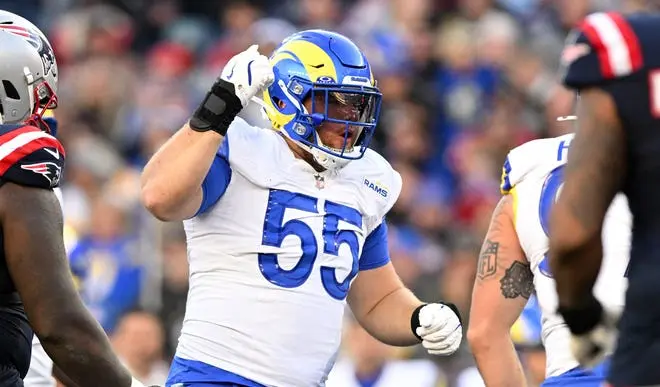
That ecosystem shapes decision-making under stress. When assignments break down, players revert to instinct. Verse and Fiske revert to instincts formed together, not separately.
This gives the Rams something rare in a post-Donald era: defensive confidence without overreliance on myth. They are not defending a legacy. They are constructing a new one piece by piece.
There will be growing pains. No defense transitions seamlessly from generational dominance. But the foundation matters, and this foundation rests on understanding rather than aspiration.
Ultimately, the Rams’ gamble is philosophical. They chose collective intelligence over individual replacement. Verse and Fiske symbolize that choice, not as saviors, but as connectors.
In time, this defense may earn its own reputation, distinct from what came before. If it does, it will not be because someone replaced Aaron Donald, but because Los Angeles stopped trying to.