The Decline of the Horse Racing Industry

The tragedy at Santa Anita Park stands as one of the darkest chapters in modern horse racing history. In the winter and spring of 2019, a series of high-profile fatalities shocked the racing world, culminating in 37 horse deaths at the storied Arcadia, California, track during a single meet. The string of breakdowns, many occurring on the main dirt surface during races or training, sparked widespread outrage from animal welfare advocates, the media, and even casual fans.
Public pressure grew so intense that authorities temporarily halted racing at Santa Anita for investigation, prompting scrutiny from the California Horse Racing Board (CHRB), state officials, and national organizations. The crisis raised profound questions about the ethics of the sport: whether the pursuit of speed, competition, and wagering revenue came at an unacceptable cost to the animals involved. Investigations followed, including probes by the Los Angeles County District Attorney, which ultimately found no criminal wrongdoing but led to sweeping safety reforms. Yet the damage to the industry’s reputation proved lasting, accelerating a broader decline that has persisted into 2026.
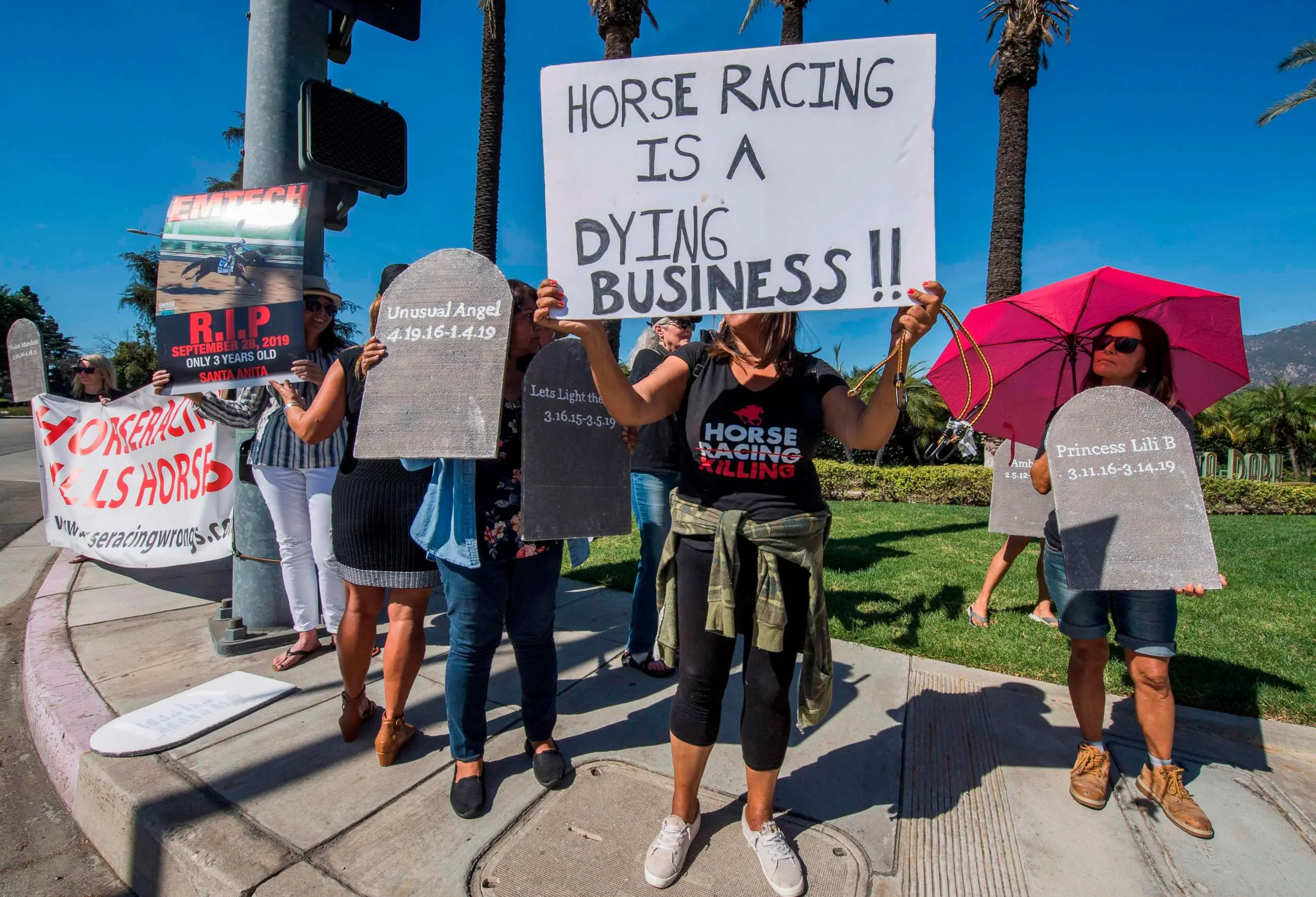
The Santa Anita fatalities were not isolated incidents but a symptom of deeper systemic issues. Critics pointed to factors such as track surface conditions, aggressive training practices, overuse of certain medications (even if legal), and the intense physical demands placed on Thoroughbreds bred for explosive performance. Animal rights groups seized on the moment, amplifying calls to end horse racing altogether, arguing that the sport inherently exploits horses for human entertainment and gambling profits. The backlash extended beyond California, fueling legislative efforts in various states to impose stricter regulations or outright bans on certain racing practices.
In the years since 2019, the industry has implemented changes—stricter medication rules under the Horseracing Integrity and Safety Authority (HISA), enhanced track maintenance protocols, and more rigorous veterinary oversight—that have reduced fatality rates significantly. Nationally, racing-related equine fatalities dropped to a record low of 0.90 per 1,000 starts in recent years, a 35% decrease from pre-HISA levels in 2021 and a 55% decline since 2009. At Santa Anita specifically, deaths have trended downward in subsequent seasons compared to the peak crisis years, though incidents continue to occur.
Despite these improvements, the shadow of Santa Anita lingers, contributing to a steady erosion of public trust and participation. Horse racing, once America’s premier spectator sport, has struggled to maintain relevance in an era dominated by faster-paced entertainment options and the explosion of legal sports betting. Wagering handle on U.S. Thoroughbred races, a key economic indicator, has followed a downward trajectory for much of the past two decades. After peaking at $15.18 billion in 2003, total handle (including worldwide commingled pools) has fallen sharply.
By 2025, it stood at approximately $11.03 billion, a 2.1% decline from 2024 and part of a pattern where handle has dropped in six of the last seven years (with only a brief post-COVID bump in 2021). Adjusted for inflation, the decline since 2003 exceeds 57%. Preliminary trends into 2026 suggest the figure could dip below $11 billion for the first time since the pandemic year of 2020, underscoring a long-term contraction.

Several interconnected factors explain this slide. The rise of widespread legal sports betting following the 2018 Supreme Court decision overturning PASPA has diverted bettors’ attention and dollars. Once horse racing enjoyed a near-monopoly on legal pari-mutuel wagering in many states, but now fans can wager on football, basketball, or even esports with simpler odds and quicker resolutions. Horse racing’s complex pari-mutuel system, with its takeout rates and exotic bets, feels outdated by comparison. Attendance at live races has plummeted—down 30% since 2000 according to The Jockey Club—and on-track crowds at many venues are a fraction of their historical peaks.
The number of races run annually has also shrunk dramatically, from over 53,000 in the early 2000s to just 29,401 in 2025, a 45% drop. Fewer races mean fewer betting opportunities, creating a vicious cycle.
The shrinking foal crop compounds these challenges. Thoroughbred registrations have fallen steadily for decades, with the 2024 crop at around 18,000—the smallest since the mid-1960s—and projections for 2026 hovering near 17,000. Economic pressures on breeders, including high costs for stud fees, veterinary care, and feed, deter investment, while the uncertain future of racing discourages new participants. Smaller crops lead to smaller fields, fewer race days, and track closures or reduced schedules. Northern California has seen particularly stark changes, with facilities like Golden Gate Fields facing uncertainty and some fairs losing racing dates.
Mid-tier tracks struggle to fill races, further depressing handle and purses.
Purse money, buoyed in recent years by casino subsidies and historical horse racing machines in states like Kentucky and Arkansas, finally declined in 2025—down 2.53% to about $1.22 billion—after holding relatively steady. This reversal signals that even revenue infusions cannot fully offset the structural contraction. At the elite level, events like the Kentucky Derby continue to draw massive wagering, but the sport’s overall ecosystem weakens as supporting races and venues fade.
Animal welfare concerns remain a persistent drag. While fatalities have decreased thanks to reforms, incidents still make headlines. In California, the CHRB reported ongoing musculoskeletal and non-musculoskeletal deaths into 2026, with Santa Anita recording several early in the year, including training and racing mishaps. Advocacy groups continue to highlight these cases, portraying the sport as inherently cruel. Public perception, shaped by viral videos and campaigns, views racing through the lens of exploitation rather than tradition or athleticism.
The industry faces an existential crossroads in 2026. Proponents argue that innovations—better data analytics for safety, expanded digital engagement, and integration with sports betting platforms—could spark a revival. Some point to growing global betting markets and potential for younger audiences via online access. Yet the trends point toward continued contraction: fewer horses, fewer tracks, declining revenue, and fading cultural relevance. The Santa Anita tragedy, though now years past, crystallized these vulnerabilities and hastened a reckoning that shows no signs of abating.
Without bold adaptation, horse racing risks becoming a niche pursuit rather than a national pastime, its glory days increasingly confined to history books and faded grandstands.