THE BOY FROM BIRCHIP: The 15-year-old boy who made history with his “impossible mission” victory at the 1948 Melbourne Cup – a miraculous story that lives on in the Victorian countryside!
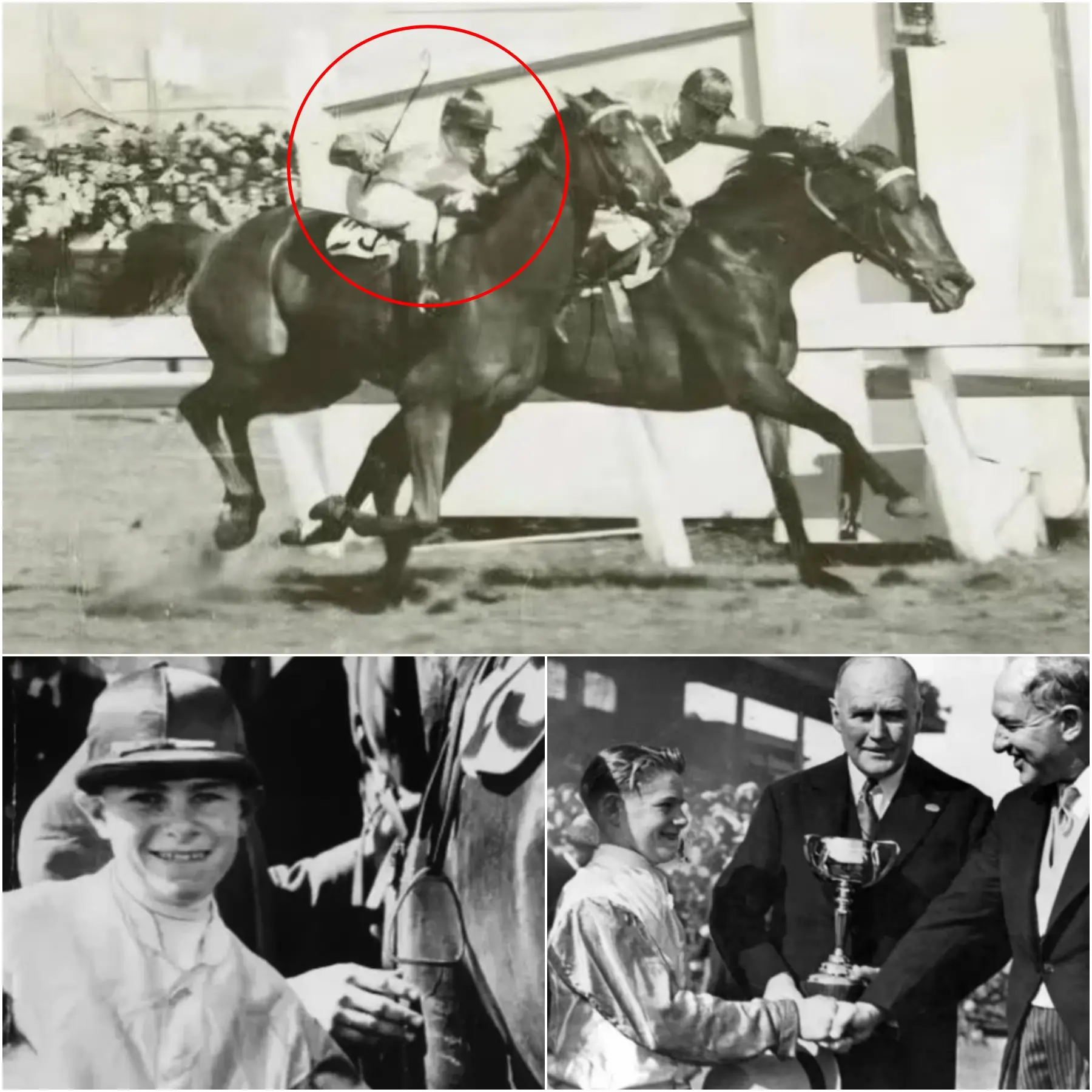
In the dusty Mallee town of Birchip, where the vast wheat fields stretch endlessly under a relentless sun, a legend was born on a soggy Tuesday in November 1948. Ray Neville, a pint-sized 15-year-old apprentice jockey who had only just received his racing licence eight weeks earlier, stepped into Australian sporting folklore by piloting the rank outsider Rimfire to a nail-biting victory in the Melbourne Cup.
What began as what many called an “impossible mission” — a raw country kid on a lame, bandaged horse dismissed at 80-1 odds — became one of the most improbable and cherished tales in the history of Australia’s greatest race. Nearly eight decades later, this miraculous story continues to echo through the Victorian countryside, recently immortalised in striking silo art that draws visitors to Birchip and reminds a new generation that dreams from small towns can conquer the biggest stages.
Ray Neville grew up in a large family of 12 or 13 children in Birchip, a quintessential one-horse town in north-west Victoria. His father, George, was a bow-legged former bush jockey who had once ridden in the Caulfield Cup before returning home to raise his brood and nurse slow gallopers. Horses were in Ray’s blood. As a boy, he competed in local shows, rode in unregistered meetings, and dreamed of following in his father’s and older brother Max’s footsteps.
Life was tough; Ray worked on farms, driving tractors, trapping rabbits, and even plucking wool from dead sheep to help put food on the table. But his heart belonged to the track.
In 1947, an old local horseman recommended the tiny teenager to prominent Mordialloc trainer Lou Robertson. Barely big enough to carry his suitcase, Ray boarded the train to Melbourne despite his mother’s concerns about feeding one less mouth at home. He started riding trackwork at Robertson’s stables, but opportunities in races were scarce. His permit came through just two months before the 1948 Cup carnival. His first ride was a winner — a stayer called Lincoln in a big field at Flemington — followed by another victory later that day. Those early successes planted the seed for something extraordinary.
Rimfire, the horse that would make history, was no glamour prospect. A handsome six-year-old chestnut trained by Stan Boydon, he had inconsistent form and sore, patchy legs. Just days before the Cup, in the Hotham Handicap, Rimfire had pulled up lame behind the favourite Howe, and there were whispers he might never race again. Leading lightweight jockey W.A. Smith, initially booked for the ride, pulled out, preferring the outsider Sun Blast and wary of Rimfire’s fitness. With less than 24 hours to go, connections scrambled for a lightweight who could carry the allotted 7 stone 2 pounds (about 45.4 kilograms).
A stablehand suggested “the boy from Birchip” after his recent win on Lincoln. Boydon booked him on the spot.
Trainer Lou Robertson kept the news secret until Cup morning to let the lad sleep. Ray had done his usual dawn trackwork when Robertson casually told him: “Hurry up and clean your gear, you’re on Rimfire in the Cup.” The boy was stunned. In the mounting yard at Flemington, the oversized jacket had its sleeves rolled and pinned, the tail tucked into his breeches.
He borrowed a lead bag from Smith, who wished him well but laughed when Ray innocently asked if the horse had a chance: “No, but he’ll give you good experience.” Bookmakers offered 80-1, and few punters bothered. The race was meant to be a learning curve for the apprentice, not a shot at glory.
The 1948 Melbourne Cup, the 83rd running of the two-mile handicap, drew a crowd of 101,000 to a rain-softened Flemington track. The field was large, with favourite Howe carrying top weight. From barrier 23, young Neville settled Rimfire well back, almost mid-field as they passed the stands the first time. As the leaders tired on the heavy ground, Rimfire began to improve. By the turn, he was up to seventh. Then, as if forgetting his ailments, the chestnut surged forward just as Howe faltered with an injured ligament.
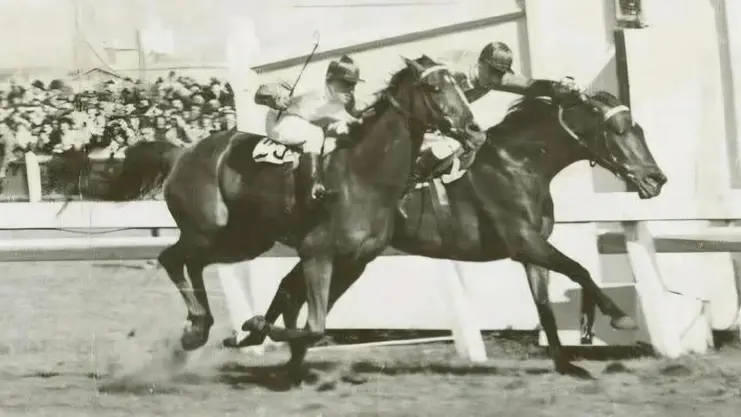
Down the long Flemington straight, Rimfire hit the front, but Sydney jockey Jack Thompson on Dark Marne was charging hard with the whip. The pair locked together in a desperate battle. Neville later recalled his excitement: “I was so excited halfway down the straight at the thought of winning the Melbourne Cup that I hardly realised Dark Marne was so close.” Thompson was convinced he had won and wheeled his mount around first, telling reporters so.
When officials called for the first-ever photo finish in Cup history — a new camera had recently been installed — the crowd held its breath. Punters booed when Rimfire was declared the winner by a nose, or as some accounts put it, a nostril or half a head. Controversy raged, with Thompson swearing to his dying day that the camera was faulty. But the judge’s decision stood: Rimfire had won in a time of 3:21.00, one of the tightest finishes the race had ever seen.
Back in Birchip, the news spread like wildfire. George Neville and his wife rushed to the Commercial Hotel to listen on the wireless. One brother snuck out of school, only for the teacher to declare a half-holiday upon hearing the result. Ray’s mother had placed a small each-way bet with the local SP bookmaker. At Flemington, the hush as the boy returned to scale was almost unparalleled.
He earned £25 for the ride — a fortune for a kid from the bush — and celebrated modestly with steak and eggs, jam tarts, baked custard, and a trip to Wirth’s Circus where he received a trophy whip. The next day, on his 16th birthday, he was back at 4am for trackwork.
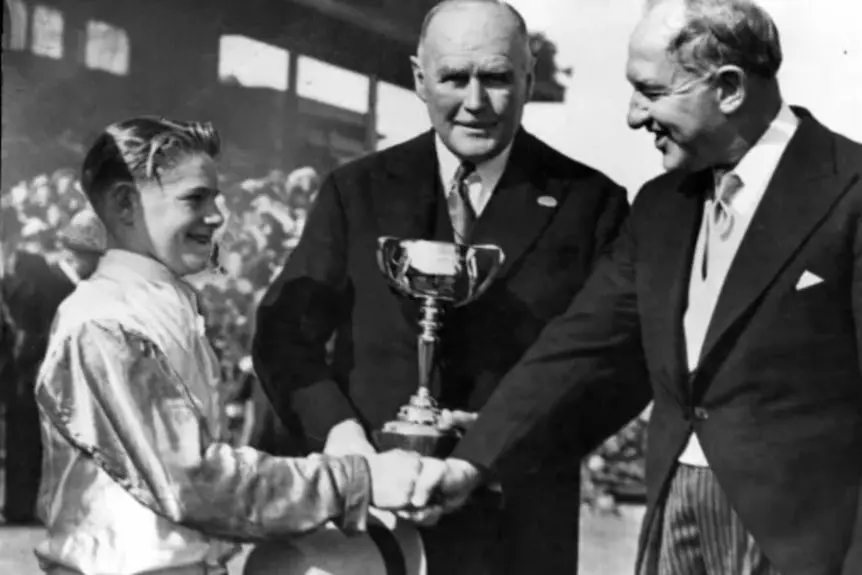
The victory stunned the nation. Photographs captured Neville alongside owner H.G. Raymond and even Governor-General William John McKell. Rimfire’s connections had pulled off the ultimate underdog triumph. Yet for Ray, fame was fleeting. Weight issues plagued him as he grew; he rode sparingly after 1948, never winning another race on the flat according to some records, though he later enjoyed a career in steeplechasing, winning the Commonwealth Steeplechase and placing in major jumps events. A bad fall in 1969 at Ballarat ended his riding days prematurely, but he continued trackwork until age 60.
He married his Mallee sweetheart June, raised eight children in Stawell, and always insisted his greatest achievement was his family, not the Cup. A modest man, he sometimes grumbled about retelling the story but allowed his wife to display the memorabilia — a tarnished trophy replica, the whip, and tiny sewn colours — on the mantelpiece.
Ray Neville passed away in December 2008 at age 76, forever holding the record as the youngest jockey to win the Melbourne Cup. His daughter Rosee remembers the tale being a staple of family life and school show-and-tell, with the photo and Cup prominently displayed. Locals in the region still speak of it with pride; one 95-year-old recalled betting on the “boy from Birchip” as a young newspaper editor and nearly cleaning up.
Today, the miraculous story lives on vividly in the Victorian countryside. In March 2026, just days ago on March 22, Birchip unveiled stunning silo art across five towering structures, painted by St Arnaud artist Kyle Torney. The mural captures the dramatic final stretches of the 1948 Cup, with Ray Neville and Rimfire battling Dark Marne in that unforgettable photo finish. The project, dreamed up years ago by the late community leader Joan Glen to boost tourism and the local economy, has already drawn caravans and visitors stopping to admire it.
Buloke Shire Mayor Graeme Milne praised its role in showcasing regional stories, while Torney called it “hugely significant” for Birchip and beyond. Rosee Neville, emotional at the unveiling, said her late father would have been “stoked” despite his humility. She described the artwork as capturing his “cheeky-boy grin” and hoped it would inspire young people: “If a kid like that can do it, I can do it. Let’s hope it inspires others and that you don’t have to be a city kid to do something like this.”
From the quiet streets of Birchip to the roar of Flemington, Ray Neville’s “impossible mission” victory remains a beacon of hope and resilience. In an era when apprentices could dream big with little experience, this 15-year-old bush boy on a crocked horse reminded Australia that miracles happen when heart, grit, and a touch of destiny align. The silo art ensures that in the Victorian countryside, where the legend began, the story will never fade — a timeless reminder that even the longest odds can yield the sweetest triumphs.