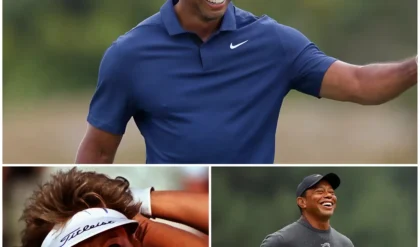
Nelly Korda revealed that she received a message from Tiger Woods ahead of the final round of the U.S. Women’s Open, a moment that immediately drew attention across the American golf world. In a sport where momentum and mental strength often matter just as much as technical skill, the involvement of a figure like Tiger Woods quickly became a talking point among fans and analysts.
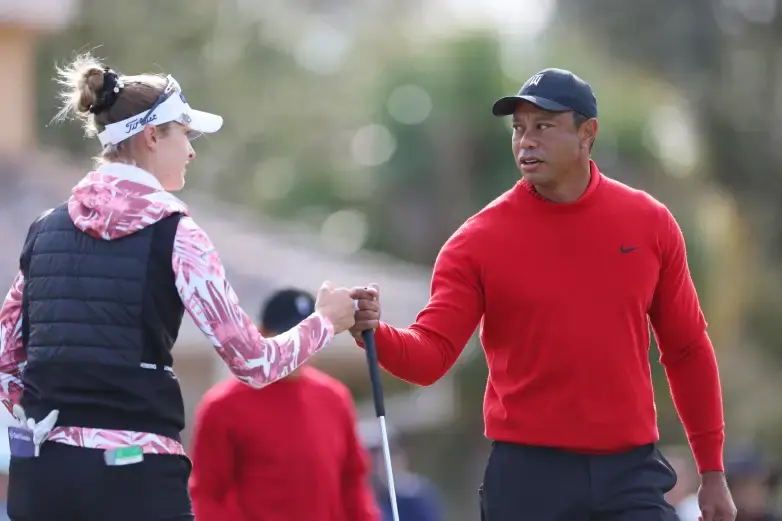
Even though the message itself was brief, its timing and source were enough to spark widespread discussion about Woods’ continued influence on the modern game. For Korda, the world No. 1 in women’s golf, the final round of a major championship already brings enormous pressure, where every shot carries weight and every decision is magnified under intense scrutiny. In that environment, even a small gesture from a legendary figure can feel significant.
According to Korda, the message served as a simple reminder to stay focused and trust her preparation. In elite golf, where margins are extremely thin, moments of reassurance like this are often less about instruction and more about mental clarity. Players at the highest level repeatedly emphasize that major championships are won not only through swing mechanics, but through emotional control and the ability to stay present under pressure.
Tiger Woods’ presence in the sport has always extended far beyond his own playing schedule. Even during long stretches where injuries have limited his competitive appearances, his influence has remained deeply embedded in professional golf. Many of today’s top players grew up watching him redefine the game, not just through victories, but through the intensity and discipline he brought to every round. Because of that legacy, even small gestures from Woods tend to carry added meaning when they become public.
What made this moment especially notable was not only the message itself, but also the timing within the context of a major championship. The U.S. Women’s Open is widely regarded as one of the most demanding events in golf, featuring difficult course setups, shifting conditions, and constant psychological pressure. Players often describe it as a test that exposes not just technical weaknesses, but mental fatigue over four consecutive days of competition.
For Korda, who has already established herself as one of the dominant figures in women’s golf, expectations are always high. Being world No. 1 brings its own layer of pressure, where every performance is measured not just against the field, but against her own standard. In that sense, entering a final round with a lead, or even in contention, becomes less about chasing a score and more about managing internal expectations.
This is where the significance of support from someone like Tiger Woods becomes more relevant. While he is not directly involved in coaching or regularly advising players, his experience in high-pressure situations is unmatched in modern golf. From historic major victories to famously difficult comebacks, Woods has repeatedly demonstrated an ability to perform under conditions where most players struggle. That history gives weight to even the simplest form of communication from him.
Social media reaction followed quickly once the story became public. Fans began discussing not only Korda’s performance, but also the broader idea of Tiger Woods’ influence across both the PGA and LPGA Tours. Some viewed the message as a straightforward act of encouragement between two elite athletes who understand the pressures of major championships. Others interpreted it as another example of how Woods continues to occupy a symbolic leadership role within the sport, even without holding any official position.
The discussion also reflected how modern sports narratives are shaped. In earlier eras, such interactions might have remained private or gone unnoticed. Today, however, even small details shared by athletes in interviews can quickly spread across digital platforms, where they are analyzed, debated, and placed into larger storylines about legacy, influence, and competitive psychology.
Korda’s response to the message added another layer to the story. Rather than framing it as pressure or external expectation, she appeared to view it as a grounding moment. That distinction is important in professional golf, where mental framing often determines how players respond to high-stakes situations. A supportive message from a respected figure can serve as reinforcement of existing preparation rather than an external demand.
From a broader perspective, the situation reflects how modern golf relationships operate across tours and generations. Influence in today’s game is not always formal or structured. It often comes through private communication, shared respect, and brief moments of connection between players who understand the demands of elite competition. Tiger Woods, because of his career achievements and cultural impact, naturally occupies a unique position within that ecosystem.
His legacy continues to function as both historical benchmark and psychological reference point. Younger players frequently reference him when discussing motivation, discipline, or the standard required to win at the highest level. Even those who compete on different tours, like the LPGA, still feel his presence in the broader narrative of the sport.
For Korda, every major championship represents a balance between opportunity and expectation. The difference between winning and finishing outside contention often comes down to small details—one putt, one recovery shot, one moment of emotional control after adversity. In that sense, mental reinforcement, whether internal or external, plays a subtle but important role.
As the tournament unfolded, attention eventually returned to on-course performance, as it always does in professional golf. Scores, leaderboard movement, and final results ultimately define the outcome of any major. However, stories like this remain part of the larger context, shaping how fans interpret the human side of competition.
The continued discussion around Tiger Woods’ message also highlights how enduring his presence remains in the sport. Even when he is not competing, his name continues to appear in conversations involving top players, major championships, and defining moments of the season. That level of sustained relevance is rare in professional sports, especially across multiple generations of athletes.
In the end, what made this story resonate was not complexity, but simplicity. A message sent quietly before one of the biggest rounds of the year. A player preparing for a defining moment in her season. And a reminder that even at the highest level of individual sport, connection still matters.
For fans, it offered a glimpse into the unseen side of professional golf, where support often comes in subtle forms rather than public gestures. For Korda, it was part of her preparation in a high-pressure environment. And for Tiger Woods, it was another example of how his influence continues to extend beyond competition, shaping moments in ways that statistics alone cannot capture.
As golf continues to evolve, with new stars emerging and new narratives forming each season, stories like this reinforce a consistent truth about the sport. While performance defines outcomes, it is often the quiet human interactions behind those performances that fans remember most.