🔥‘TECHNOLOGY IS A JERK’ Gerard Whateley delivered a scathing speech about the AFL’s scoring system, which has sparked considerable controversy among fans.

In a blistering on-air tirade that has divided the football community, veteran broadcaster Gerard Whateley has launched one of his most ferocious attacks yet on the AFL’s use of technology in goal scoring. Speaking on SEN’s Crunch Time and later expanding his views on Fox Footy’s AFL 360, Whateley described the league’s Review Centre (ARC) as an out-of-control “addiction to meddling” that is trampling the very fabric of the game.
His comments, delivered with visible anger in the wake of a controversial decision during last Friday night’s Showdown between Adelaide and Port Adelaide, have ignited a fierce debate about the role of technology versus human judgment in Australian football.
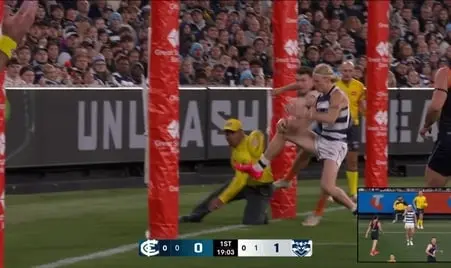
The flashpoint came midway through the third quarter of the 59th Showdown at Adelaide Oval. With the Crows trailing by 13 points, Jake Soligo received a handball just outside the goalsquare and snapped a high, arching kick toward goal. The experienced goal umpire, perfectly positioned directly beneath the flight of the ball and against the goalpost, had an unobstructed view in real time. Without hesitation, he signaled a goal. The crowd erupted. But 1 minute and 40 seconds later, the “voice of God” from the ARC intervened.
After reviewing multiple camera angles, officials ruled that the ball had crossed the line “over the top of the goalpost,” downgrading the score to a behind. Adelaide eventually won by a single point thanks to Brayden Cook’s dramatic late major, but the incident left a sour taste.
Whateley did not hold back. “The real problem for the game is what happened with the ARC last night, which is the greatest overreach we have seen yet,” he declared. “This is the worst intervention from the ARC. This has been building, and this is going to get worse unless somebody steps in and stops it.” He pointed out the irony with brutal clarity: just days earlier, AFL executive general manager of football performance Greg Swann had publicly assured the football world that goal umpires would be trusted.
“If you are confident, go with your call and we will back you. We will not come over the top and second guess,” Swann had said on AFL 360 the previous Wednesday. The policy was meant to reduce unnecessary delays and restore faith in on-field officials. It lasted less than a week.
“This is straight-out meddling and it’ll ruin the game,” Whateley fumed. “When you give humans the capacity to intervene, it becomes a compulsion to interfere. What we have now is an addiction to meddling.” He described the goal umpire’s positioning as textbook: “Watch the goal umpire’s position against the goalpost and how he gets himself directly underneath the flight of the ball. He knows.
There’s no second-guessing.” Then came the line that has since gone viral across social media: “The kids can’t be trusted with the technology.” Delivered with tongue slightly in cheek but unmistakable frustration, it encapsulated Whateley’s view that remote reviewers, armed with slow-motion replays and multiple angles, are overriding clear on-field decisions in pursuit of a perfection that doesn’t exist.
The controversy is not new. Throughout April, Whateley had already expressed growing alarm at a string of ARC interventions he deemed pointless or counterproductive. In one particularly heated segment, he labeled a review “rubbish” and suggested the responsible parties hand back their paychecks. But the Soligo decision, coming so soon after Swann’s explicit promise to dial back ARC power, felt like a betrayal. Whateley made no secret of his disgust: “That goal umpire was told by his coaches – who were told by Greg Swann – ‘if you are certain of it, we will back you’.
It didn’t last two days. It’s so disappointing and it’s really damaging the game.”
Fan reaction has been swift and polarised. On social media platforms and talkback radio, thousands have weighed in. Many agree with Whateley, arguing that the constant second-guessing is sucking the joy and flow out of the game. “Scrap the ARC,” one popular comment read. Others pointed out that Adelaide still won and questioned why the league is so obsessed with microscopic accuracy on calls that have been part of the sport for over a century. “The goal umpire was right there. Why do we need people in a bunker overriding him?” asked another.
Yet a vocal minority defends the technology, insisting that any tool that reduces umpiring errors is worth the occasional delay and controversy. The AFL itself has remained largely silent on the latest flare-up, though Swann’s earlier admissions of past ARC mistakes suggest the league is aware of the growing discontent.
The deeper issue Whateley is highlighting is philosophical. Australian rules football has always prided itself on its human element – the split-second decisions of umpires who are part of the spectacle, not hidden away in a control room. The introduction of the ARC was sold as a way to protect the integrity of scoring, particularly after several high-profile howlers in previous seasons. But critics, led now by one of the game’s most respected voices, argue that the cure has become worse than the disease.
Every review creates doubt, every overturned call fuels conspiracy theories, and every delay disrupts the rhythm that makes the sport so compelling. Whateley’s repeated warnings that technology is eroding the soul of the game echo similar debates in soccer over VAR and in cricket over the Decision Review System. In each case, the promise of greater accuracy has collided with the reality of slower, more clinical, and often less satisfying spectacles.
What makes Whateley’s intervention particularly potent is his long-standing credibility. A respected journalist and commentator with decades of experience, he is not a reflexive traditionalist. He has supported many modernisations of the game. His anger therefore carries weight. When he says the current system is “trampling all over the game” and “meddling where you are not required,” listeners know it is not mere nostalgia speaking.
He is articulating a fear shared by many that the AFL is sleepwalking into a future where every score is provisional, every umpire’s call is provisional, and the only certainty is that the bunker will have the final word.
The league now faces a genuine dilemma. Reining in the ARC risks accusations of tolerating errors. Expanding its powers invites further accusations of overreach and “ruining the game,” as Whateley puts it. Somewhere in between lies a sensible middle ground – perhaps stricter guidelines on when reviews can be initiated, time limits on deliberations, or a return to greater trust in the men and women in fluorescent green on the field. Greg Swann’s April policy shift was clearly an attempt to find that balance. Its rapid unraveling in the Showdown has only intensified the spotlight.
As the dust settles on another round of controversy, one thing is clear: Gerard Whateley has thrown down a gauntlet. His scathing assessment that technology has become a “jerk” interfering where it is neither wanted nor needed has resonated far beyond the usual football chatter. Whether the AFL listens – and acts – before the next high-stakes match will determine if this latest storm fades into memory or becomes a defining moment in the ongoing battle between tradition and technology. For now, the conversation rages on, and Whateley’s voice remains one of the loudest and most urgent in the room.
The game deserves better, the players deserve better, and the supporters who pay to watch deserve a product that feels authentic rather than endlessly second-guessed from afar. The coming weeks will reveal whether anyone in the corridors of power is prepared to do something about it.