The thin air at Coors Field has always done strange things to baseballs. On certain nights in Denver, routine fly balls carry a little farther, curveballs bite a little less, and underdogs suddenly look dangerous. But on this particular weekend, something else seemed to hang in the air—something heavier than altitude, more volatile than momentum. Suspicion.

The Los Angeles Dodgers arrived in Colorado expecting business as usual. They were the powerhouse, the big-budget machine built to dominate. Across the diamond stood the Colorado Rockies, a team buried near the bottom of the standings, a roster few believed could seriously threaten Los Angeles over a full series. On paper, it wasn’t supposed to be close.
But baseball is rarely played on paper.
From the first innings, something felt off. Rockies hitters came out swinging—not cautiously, not reactively, but aggressively, almost preemptively. Pitch after pitch, especially the first one of each at-bat, was met with confident, decisive swings. Not guesses. Not desperation. Precision.
Inside the Dodgers’ dugout, eyes began to narrow.

Behind the plate, rookie catcher Dalton Rushing was seeing it unfold pitch by pitch. Calling games at the highest level is as much instinct as it is preparation. You study tendencies, read swings, anticipate adjustments. But what he was witnessing didn’t quite fit the usual patterns.
Hitters who typically struggled to make early contact were jumping on first pitches with uncanny timing. Breaking balls that should have induced hesitation were being attacked immediately. It wasn’t just success—it was the manner of it.
After another tough loss, Rushing stepped in front of reporters, choosing his words carefully but not cautiously enough to avoid igniting a fire.
He described it as “a little fishy.”
That single phrase was enough.
The implication hung there, unmistakable. In a sport still haunted by past scandals, suggesting something “fishy” is never just about timing or luck. It hints at something deeper—something potentially illicit. Major League Baseball has spent years trying to restore trust after controversies involving sign-stealing and technology blurred the lines between gamesmanship and cheating.
And now, here it was again. Or at least, the suggestion of it.

Rushing didn’t present evidence. He didn’t accuse outright. But in baseball, you don’t need to say the word “cheating” for everyone to hear it.
The numbers, at least on the surface, offered a more grounded explanation. Colorado had been one of the most aggressive first-pitch hitting teams in the league, swinging early nearly 40% of the time. That approach, risky as it may be, can pay off—especially against pitchers trying to get ahead in the count with predictable strikes.
Still, context matters. The Rockies had struggled mightily overall, especially on the road. Their sudden surge against one of the league’s elite teams didn’t just raise eyebrows—it raised questions.
Backlash came swiftly.
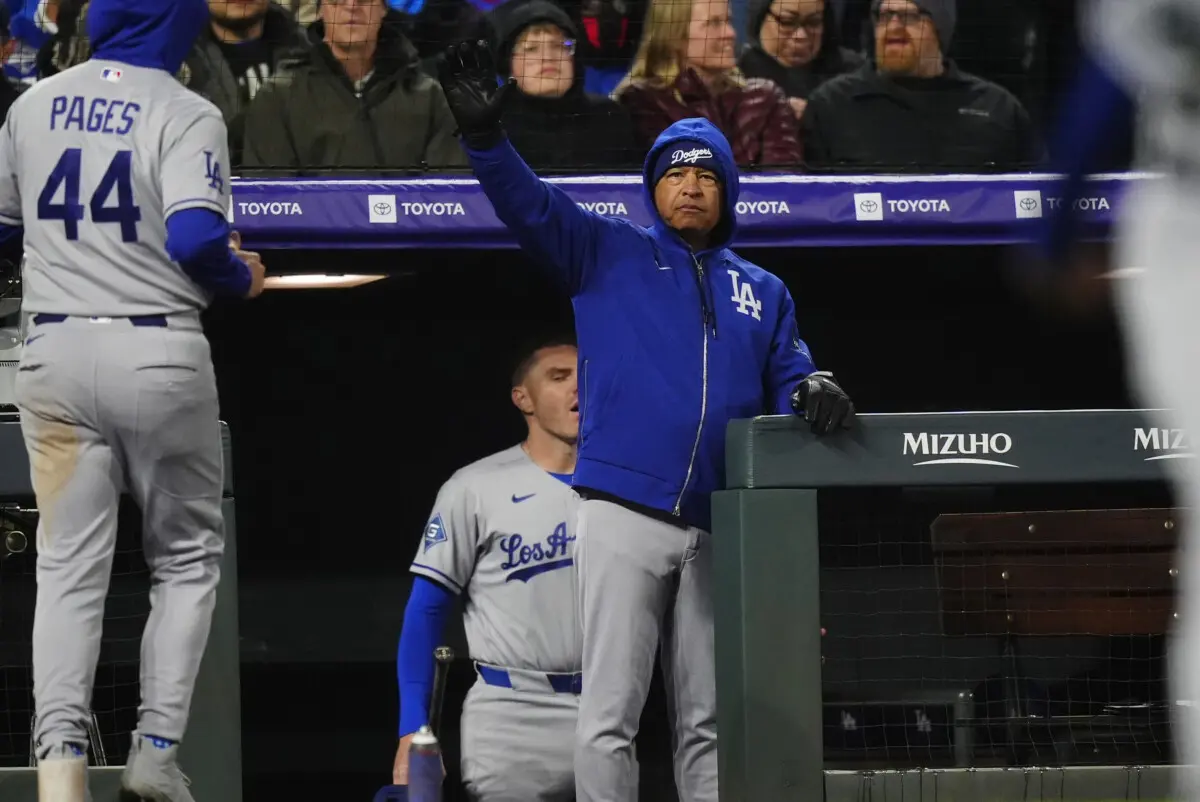
Fans across social media mocked the suggestion. Analysts pointed to simpler explanations: poor pitch execution, predictable sequencing, or simply a team having a good series at the right time. Even within the Dodgers’ orbit, the tone seemed to soften. Manager Dave Roberts, when pressed, downplayed the idea of anything suspicious, instead pointing toward mistakes on the mound.
Baseball, after all, has a long memory—and a long list of reasons to be cautious about accusations.
The shadow of the Houston Astros sign stealing scandal still lingers over the sport. That episode revealed how far a team could go to gain an edge, using technology to decode pitches in real time. It reshaped how players, coaches, and fans interpret anything that feels even slightly out of place.
In that context, Rushing’s comments didn’t land in a vacuum. They landed in a sport already conditioned to suspect the worst.
But suspicion alone doesn’t equal proof.
There were no unusual signals spotted. No devices. No evidence of communication beyond what naturally happens between teammates reading a pitcher’s tendencies. In modern baseball, with encrypted communication systems between pitchers and catchers, the pathways for traditional sign-stealing have narrowed considerably.
What remained was something less tangible: doubt.
For the Rockies, the accusation—implicit as it was—became bulletin board material. A struggling team suddenly had something to rally around. Whether they were underestimated, disrespected, or simply playing above expectations, the narrative shifted. They weren’t just winning—they were being questioned.
And sometimes, that’s all the motivation a team needs.
For the Dodgers, the episode exposed a different kind of vulnerability. Not physical, not tactical, but psychological. Dominant teams are expected to win. When they don’t, the search for explanations can drift beyond mechanics and into suspicion.
It’s a dangerous line.
Because in baseball, failure is built into the game. Even the best teams lose dozens of times each season. Even the best pitchers get hit. The difference between dominance and doubt can be as thin as a few misplaced fastballs—or a few well-timed swings.
As the series faded into the long grind of the season, the noise began to quiet. No investigation followed. No penalties were issued. No evidence surfaced to support anything beyond what could be explained by approach, preparation, and execution.
But the moment lingered.
Not because it proved anything—but because it revealed something.
In a sport defined by its rhythms and routines, where every pitch is a calculated decision, the idea that someone might know what’s coming is enough to unsettle even the most composed players. It taps into a deeper fear—the loss of control in a game built entirely around it.
And so, what happened in Colorado wasn’t just about a few games in April. It was about perception. About how quickly confidence can turn into suspicion. About how the ghosts of past scandals still echo through present moments.
The Rockies moved on, their wins recorded, their approach unchanged. The Dodgers regrouped, their focus returning to execution rather than speculation.
But for a brief moment, under the thin Denver air, baseball felt heavier than usual.
Not because of what was proven.
Because of what was implied.