The cameras were still rolling when the question landed, but the tone inside the studio had already shifted. It wasn’t just another routine segment on Fox Footy’s “On The Couch.” There was an edge in the air, the kind that signals something deeper than casual post-match analysis. When Jack Riewoldt leaned forward in his chair, his expression said more than his words ever could. He had seen enough.

“Is Adem Yze’s tactics outdated…?”
It wasn’t framed as an attack, at least not on the surface. But anyone who has followed the rise and unraveling of Richmond’s once-feared system could hear the weight behind it. This wasn’t just commentary. It was a warning shot from someone who knew the club from the inside out.
For years, Richmond’s identity had been unmistakable. Relentless pressure. Territory football. Chaos that somehow felt controlled. Under former coach Damien Hardwick, the Tigers turned unpredictability into a weapon, overwhelming opponents with speed and instinct. It brought premiership glory and a reputation that made rivals uneasy before the first bounce.
Now, that identity feels like a distant echo.
Riewoldt didn’t hesitate as he dissected what he had witnessed in Richmond’s recent clash with the Giants. The frustration was visible, not just in his words, but in the way he recounted the moments that stuck with him. There were passages of play where composure was an option—where control, patience, and precision could have shifted momentum. Instead, he saw something else entirely.

Long kicks. Hopeful disposals. A pattern that repeated itself with unsettling consistency.
“They just kept going long,” he said, his voice cutting through the studio calm. It wasn’t just a tactical observation—it was an indictment. In modern Australian rules football, where systems are increasingly sophisticated and ball movement is carefully engineered, blind territory play can quickly become a liability.
What unsettled Riewoldt most wasn’t just the decision-making itself. It was who was making those decisions.
These weren’t just inexperienced players cracking under pressure. These were veterans—players who had lived through Richmond’s golden era, who understood the nuances of the game at its highest level. Yet even they seemed to default to the same hurried approach, sending the ball forward without clear intent, as if trusting chaos to somehow deliver results.
Hope is not a strategy.
That’s the unspoken truth behind Riewoldt’s critique. And in a competition as unforgiving as the AFL, it’s a truth that exposes teams quickly.
Sitting across from him, Jordan Lewis posed a question that cut even deeper: did Richmond still have a clear identity?

It’s the kind of question clubs spend years trying to answer. Identity defines not just how a team plays, but who they are when the game is on the line. It shapes decision-making under pressure. It builds trust between teammates. It gives supporters something to believe in.
Riewoldt’s response came without hesitation.
No.
Not “maybe.” Not “it’s evolving.” Just no.
In that single word, he captured what many Richmond supporters have quietly feared. The Tigers are no longer the team they once were—but they haven’t yet become something new. They exist in a kind of tactical limbo, caught between a fading blueprint and an unformed future.
At the center of this uncertainty is Adem Yze, a coach still carving out his identity at the highest level. Taking over a club with Richmond’s recent history was never going to be simple. Expectations don’t reset overnight. The shadows of premiership success linger, shaping perceptions and raising the bar for every decision.
Yze’s challenge is not just to win games—it’s to redefine what Richmond football looks like in a new era.
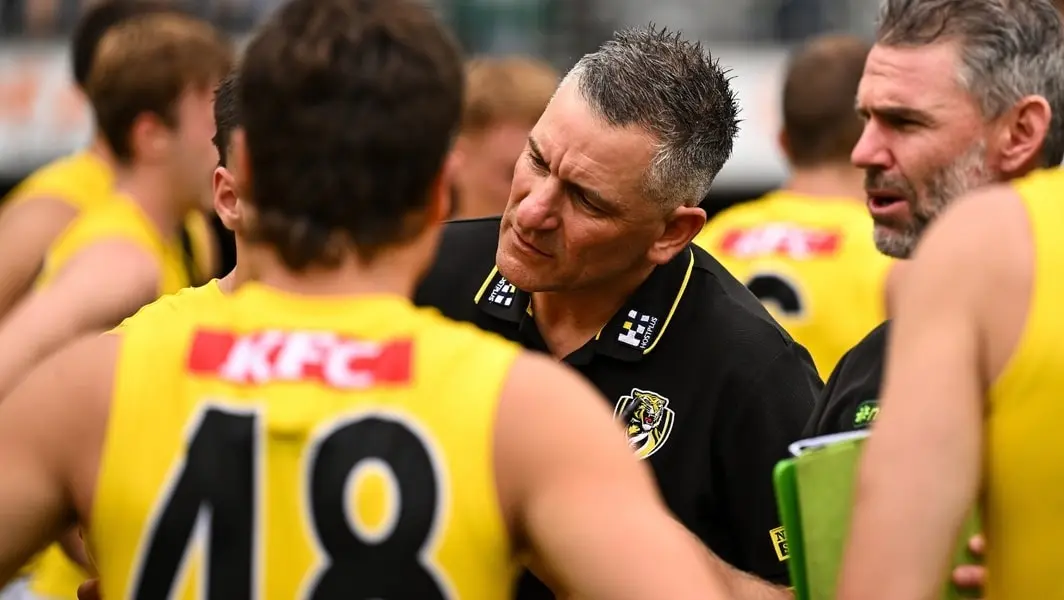
But that transformation comes with risk. Stick too closely to the old system, and the team risks becoming predictable, easy to counter. Change too much, too quickly, and cohesion can fracture, leaving players uncertain and reactive.
What Riewoldt highlighted wasn’t just a tactical flaw. It was a symptom of something larger: hesitation. A lack of clarity. A team unsure of its instincts.
And in elite sport, hesitation is often the difference between control and collapse.
The match against the Giants offered a snapshot of that struggle. Moments that should have been opportunities turned into turnovers. Plays that demanded composure dissolved into rushed decisions. Each long kick forward, each hurried disposal, told the same story—a team searching for answers in real time, often coming up short.
For supporters, it’s a frustrating watch. Not because losing is unfamiliar, but because the manner of it feels disconnected from the club’s identity. Richmond built its reputation on controlled chaos, not careless execution. There was always a method beneath the madness. Now, that method is harder to find.
Yet criticism like Riewoldt’s carries weight precisely because it comes from a place of understanding. He isn’t an outsider throwing stones. He’s a product of the system that once made Richmond great. He knows what it looks like when it works—and what it feels like when it doesn’t.
His words aren’t just analysis. They’re a challenge.
To the players: trust your skills, not just territory.
To the coaches: define the plan, and make it unmistakable.
To the club: decide who you are, and commit to it fully.
Because in the AFL, ambiguity doesn’t last long. Teams either evolve or they fall behind. There is no comfortable middle ground.
As the segment wrapped and the conversation moved on, the question lingered.
Are Adem Yze’s tactics outdated—or is this simply the growing pain of a team in transition?
The answer isn’t simple. It rarely is in football. But one thing is clear: Richmond stands at a crossroads. The path forward will demand more than effort. It will require clarity, conviction, and a willingness to confront uncomfortable truths.
And perhaps that’s why Riewoldt didn’t hold back.
Because sometimes, the most important voices aren’t the ones that reassure—they’re the ones that force you to look in the mirror and ask whether what you’re doing is still good enough.
For Richmond, that question is no longer hypothetical.
It’s urgent.