SEABISCUIT, A SYMBOL OF HOPE DURING THE CRISIS: The story of Seabiscuit’s rise from the mud has become a symbol of the strength and spirit of the American people during the Great Depression.
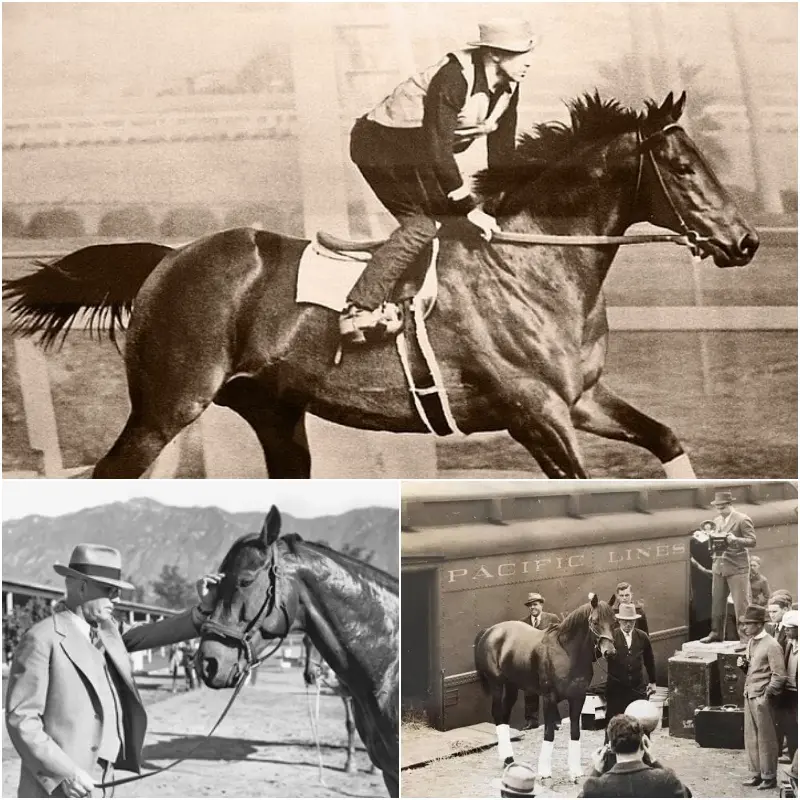
In the depths of the Great Depression, when unemployment ravaged families and hope seemed scarce, an unlikely hero emerged not from boardrooms or Washington, but from the dusty racetracks of America. Seabiscuit, a small, knobby-kneed thoroughbred once dismissed as lazy and worthless, captured the nation’s imagination and became a powerful emblem of resilience and triumph over adversity. His journey from overlooked underdog to champion mirrored the struggles and aspirations of millions of ordinary Americans fighting to survive economic catastrophe.
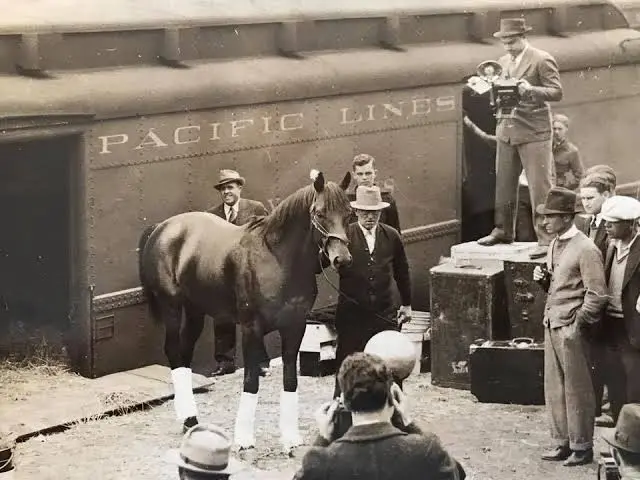
Born on May 23, 1933, in Lexington, Kentucky, Seabiscuit was sired by Hard Tack, a son of the legendary Man o’ War, giving him an impressive pedigree on paper. Yet his early life showed little promise. Standing just 15.2 hands high—small for a racehorse—he had a crooked left foreleg and an awkward gait. Trainers labeled him indolent; he preferred sleeping and eating over training. In his first two years of racing, he lost far more than he won, often finishing in the back of the pack.
Sold cheaply and used initially as a training dummy for faster horses, Seabiscuit seemed destined for obscurity.
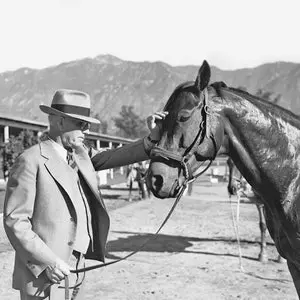
Everything changed in 1936 when automobile tycoon Charles S. Howard purchased the horse for a modest sum. Howard, still grieving the tragic death of his young son in a car accident, found solace in the unassuming animal. He entrusted Seabiscuit to Tom Smith, a quiet, unconventional trainer known for his intuitive understanding of horses. Smith recognized potential where others saw failure. He observed Seabiscuit’s quirks—his love of company, his need for calm—and paired him with Red Pollard, a down-on-his-luck jockey who had lost much of his sight in one eye due to racing injuries.
Pollard, like Seabiscuit, was battered by life: broke, injured, and overlooked. Together, this mismatched trio formed an unbreakable bond.
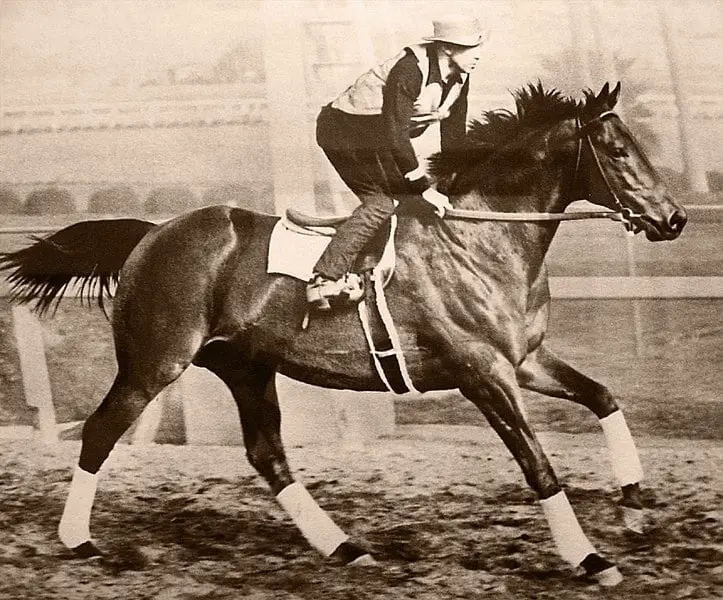
Under Smith’s patient guidance, Seabiscuit began to transform. The horse’s workouts revealed explosive speed and remarkable heart. In 1937, he exploded onto the scene, winning race after race on the West Coast tracks. His victories were not just athletic feats; they were bursts of joy in a bleak era. Newspapers chronicled every step, and radio broadcasts brought his triumphs into living rooms across the country. Seabiscuit became more than a horse—he was a story Americans desperately needed. While factories stood idle and breadlines stretched long, here was proof that the little guy could win.
The pinnacle came on November 1, 1938, in what was billed as the “Match of the Century” at Pimlico Race Course in Baltimore. Seabiscuit faced War Admiral, the elegant 1937 Triple Crown winner owned by the prestigious East Coast racing establishment. War Admiral, a son of Man o’ War and Seabiscuit’s distant relative, was the heavy favorite—sleek, dominant, and unbeaten in many starts. The contrast could not have been starker: polished aristocracy versus scrappy commoner. An estimated 40,000 fans packed the stands, while another 40 million listened on radio, including President Franklin D.
Roosevelt, who paused a cabinet meeting to tune in.
The race unfolded dramatically. War Admiral burst to an early lead, but Seabiscuit, with Pollard aboard, stayed close. In a bold move, Pollard let Seabiscuit surge ahead on the backstretch. The underdog pulled away steadily, crossing the finish line four lengths in front. The victory sent shockwaves through the nation. Seabiscuit had not only beaten the champion but had done so with heart and determination. In that moment, he embodied the spirit of a people refusing to be defeated.
As one historian noted, the race offered a temporary respite from daily hardships, reminding Americans that perseverance could overcome even the most daunting odds.
Seabiscuit’s success continued. He became the leading money-winner of his time and was named American Horse of the Year in 1938. Injuries plagued him, including a severe leg problem that nearly ended his career, but he staged a remarkable comeback. His story inspired books, films—including the acclaimed 2003 movie adaptation—and generations of admirers. Even today, races like the Seabiscuit Handicap at Del Mar carry his name forward, with recent runnings in 2025 showcasing upsets and thrilling finishes that echo his own improbable triumphs.
While Seabiscuit’s era defined an underdog’s rise during crisis, horse racing has seen other icons of greatness. In 1973, Secretariat delivered one of the most astonishing performances in sports history at the Belmont Stakes. The chestnut colt, already a Triple Crown contender after wins in the Kentucky Derby and Preakness, demolished his rivals by an unprecedented 31 lengths. His time of 2:24 for the mile-and-a-half distance remains an unbroken record on dirt.
Track announcer Chic Anderson famously called him “a tremendous machine.” When Secretariat died in 1989, veterinarians conducting the necropsy were stunned to discover his heart weighed an estimated 22 pounds—nearly twice the size of a normal Thoroughbred’s—providing a physical explanation for his extraordinary stamina and power.
Yet Seabiscuit’s legacy endures differently. Secretariat’s dominance was superhuman; Seabiscuit’s was profoundly human. He rose not through innate perfection but through grit, partnership, and second chances. In an age of economic despair, he showed that even those counted out could rise from the mud—literally and figuratively—to claim victory. His story reminded a struggling nation that hope often arrives in the most unexpected forms: a small horse with a big heart, carrying the dreams of millions on his back.