BETTING SHOCK ROCKS SUPER BOWL LX: Why the Patriots Are Underdogs Despite a Historic Run—and Why That Might Be Their Greatest Weapon
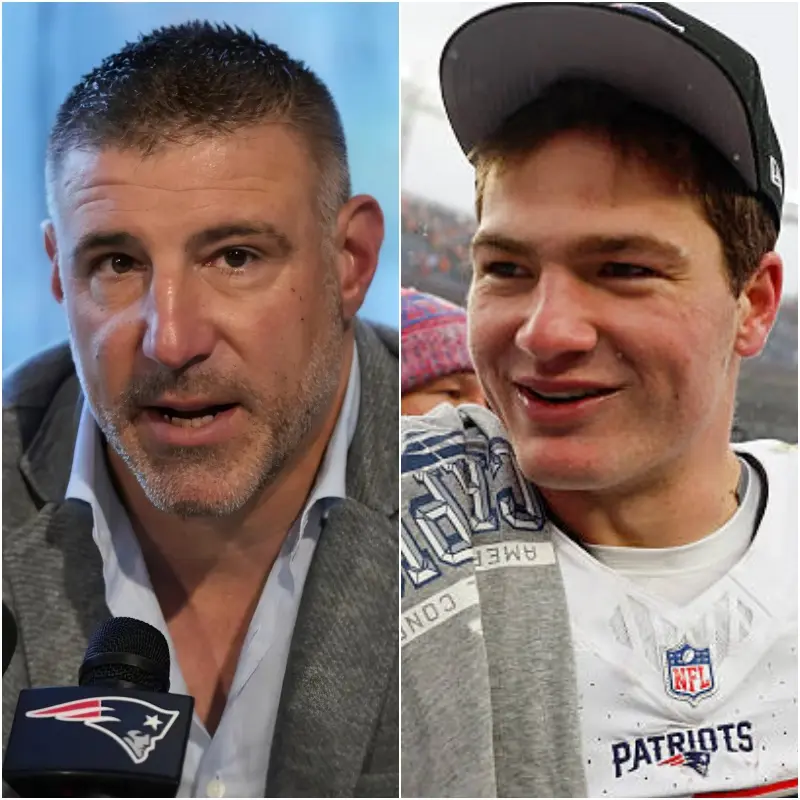
As Super Bowl LX approaches in Santa Clara, one storyline has quietly evolved into the most polarizing debate of the postseason: how can a New England Patriots team with a flawless 9–0 road record and an MVP-caliber quarterback still be listed as underdogs?
Yet that is exactly where the betting markets stand.
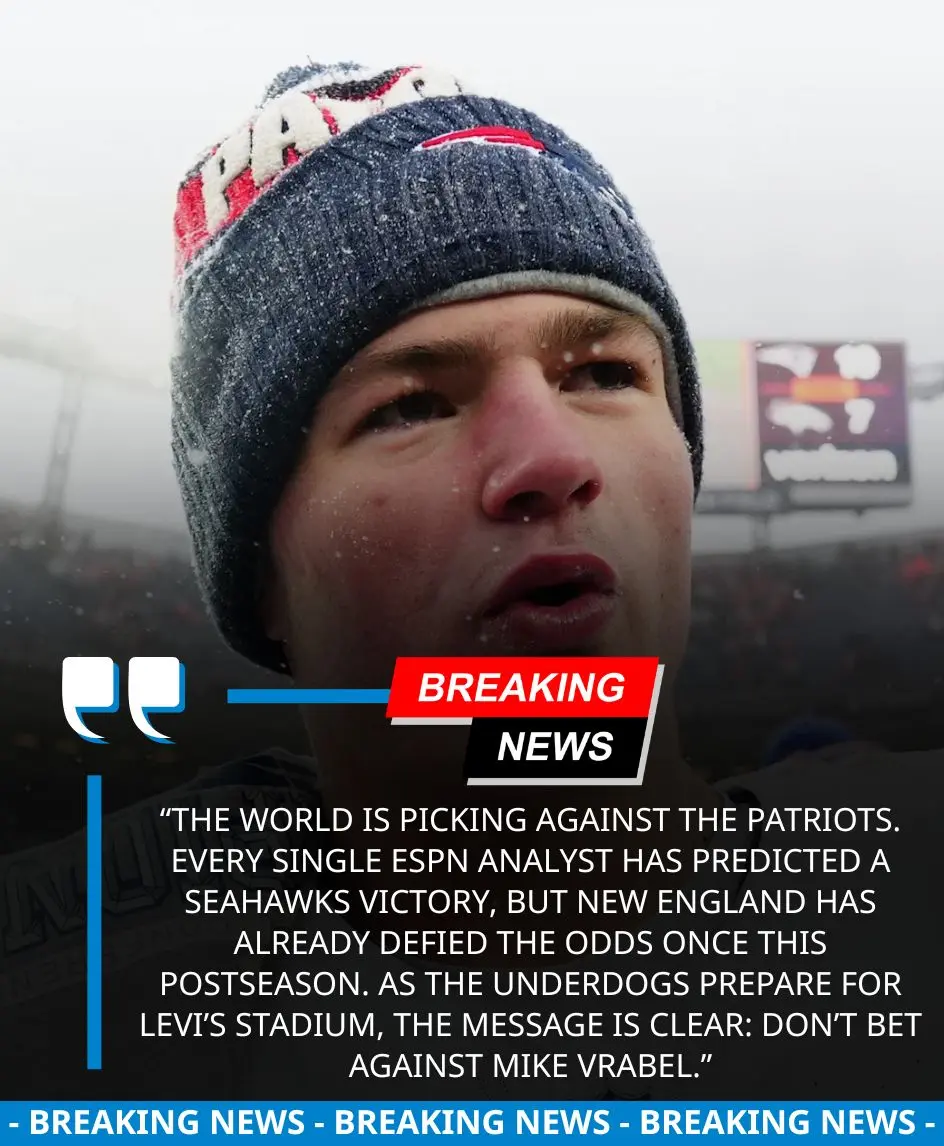
Despite one of the most improbable postseason runs in franchise history, the Patriots have opened as 4.5-point underdogs against the Seattle Seahawks. ESPN analysts, almost to a person, have picked Seattle to lift the Lombardi Trophy. Sportsbooks have followed suit. And the national conversation has largely centered on what Seattle does well—rather than what New England has already proven.
Inside the Patriots’ locker room, however, the reaction has been anything but discouraged. If anything, the betting lines have ignited something familiar in Foxborough.
Mike Vrabel’s team believes the disrespect is real—and useful.
A Historic Road Run That Refuses to Be Ignored
Winning on the road in the NFL is difficult under normal circumstances. Winning nine consecutive road games in a single season is nearly unheard of.
Yet that is precisely what this Patriots team has accomplished.
From hostile environments in Buffalo and Kansas City to playoff pressure cookers in Baltimore and San Francisco, New England has not merely survived—it has controlled games with a composure that belies the relative youth of its roster.
Analytically, the road dominance is not a fluke. According to advanced metrics, the Patriots rank near the top of the league in opponent-adjusted efficiency away from home. Their average margin of victory on the road sits comfortably above league average, and their turnover differential outside Gillette Stadium has been elite.
These are not lucky wins. They are systematic.
Still, skeptics argue that road success does not automatically translate to Super Bowl dominance, particularly against a Seattle team built on speed, balance, and postseason experience.
Drake Maye’s MVP-Caliber Leap
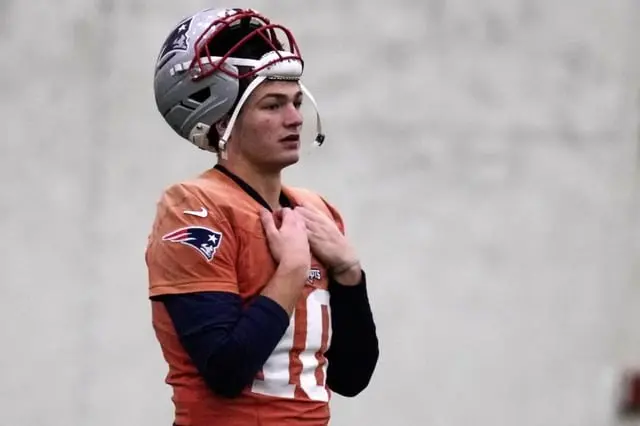
At the center of New England’s rise is quarterback Drake Maye, whose second season has rewritten expectations.
Once viewed as a long-term project, Maye has accelerated his development at a pace that has stunned evaluators across the league. His command of the offense, ability to extend plays, and willingness to attack tight windows have transformed the Patriots from a conservative, defense-first team into a multidimensional threat.
Statistically, Maye’s résumé stacks up with any quarterback left standing. He enters Super Bowl LX ranked among league leaders in total touchdowns, explosive passing plays, and third-down efficiency. His performance in high-leverage moments—particularly in late-game scenarios—has fueled the MVP conversation.
Yet despite those numbers, national narratives have been slow to embrace him as the defining player in this matchup.
Part of that hesitation stems from Seattle’s defensive reputation. The Seahawks boast one of the most versatile secondaries in football, capable of disguising coverage and forcing quarterbacks into hesitation. Analysts argue that Maye has yet to face a defense with this combination of speed and discipline on the game’s biggest stage.
Inside New England, that skepticism is being logged carefully.
ESPN’s Unanimous Pick—and the Power of Perception
Perhaps the most striking development of Super Bowl week has been the near-unanimous support for Seattle among ESPN analysts.
Panel after panel has leaned toward the Seahawks, citing their playoff-tested core, offensive balance, and ability to dictate tempo. The consensus view is that Seattle’s experience outweighs New England’s momentum.
Perception matters in betting markets. When influential voices align, public money often follows. Early wagering trends suggest casual bettors are siding heavily with Seattle, reinforcing the underdog label for the Patriots.
But history suggests that unanimity can be dangerous.
The NFL has long been defined by teams that thrive when expectations tilt against them. Few franchises understand that dynamic better than New England.
Mike Vrabel and the Culture of Calculated Defiance
Head coach Mike Vrabel has never shied away from an edge-driven mentality.
A former player who built his reputation on toughness and preparation, Vrabel has quietly instilled a culture that values external doubt as internal fuel. He does not publicly rail against analysts or betting lines. Instead, he reframes them as information—something to be absorbed, not argued with.
Sources around the team describe a locker room that has embraced the “bulletin board material” narrative not as a slogan, but as a process. Clips of analyst predictions circulate. Betting spreads are acknowledged. Then they are put aside.
Vrabel’s message has been consistent: outcomes are not decided by consensus.
That philosophy has resonated, particularly with a roster that blends veteran leadership with emerging stars eager to define their own legacy.
The Seattle Case: Why the Seahawks Are Favored
To understand the betting shock, one must understand Seattle’s appeal.
The Seahawks enter Super Bowl LX as one of the most balanced teams in football. Offensively, they can shift seamlessly between a power running game and explosive downfield passing. Defensively, they are disciplined, fast, and opportunistic.
Their playoff run has been efficient rather than flashy, marked by situational excellence and few self-inflicted mistakes. In the eyes of many analysts, Seattle looks like the safer choice—the team less likely to beat itself.
That perception drives betting behavior.
Oddsmakers are not in the business of predicting outcomes; they are in the business of balancing risk. Seattle’s profile attracts public confidence, while New England’s rise still feels, to some, like a sudden surge rather than a sustained identity.
Why the Line Might Be Misleading
Digging deeper into the matchup reveals reasons the spread may not tell the full story.
New England’s defense matches up well with Seattle’s offensive tendencies, particularly in limiting yards after catch and forcing longer drives. The Patriots have excelled at bending without breaking, an approach that frustrates teams accustomed to quick-strike scoring.
Offensively, Maye’s mobility presents a challenge Seattle has not consistently faced this postseason. His ability to extend plays stresses coverage rules and opens opportunities late in downs, where New England has thrived.
Special teams, often overlooked in betting analysis, also favor the Patriots. Field position has been a quiet strength throughout their run, particularly in road environments.
These are the margins where Super Bowls are decided.
Fake News—or a Plausible Underdog Story?
Labeling this narrative as “fake news” does not mean it lacks logic. Instead, it reflects how modern sports discourse often oversimplifies complex realities.
The idea that a 9–0 road team led by an MVP-caliber quarterback could be an underdog feels counterintuitive. Yet when framed through market psychology, media narratives, and public perception, the line becomes understandable—even exploitable.
At this moment in time, the Patriots are not being dismissed because they are weak. They are being doubted because Seattle feels familiar, predictable, and safe.
History suggests that safety is not always rewarded in February.
The Super Bowl Stage and the Weight of Expectation
Super Bowls are rarely won by consensus favorites alone. They are won by teams capable of absorbing pressure, adjusting in real time, and capitalizing on moments that defy pregame logic.
New England has spent this entire postseason doing exactly that.
The betting shock surrounding Super Bowl LX may ultimately say less about the Patriots’ chances and more about how narratives are formed. In a league driven by storylines, the underdog label can be both a burden and a gift.
For Mike Vrabel’s squad, it appears to be the latter.
As kickoff approaches in Santa Clara, one truth stands out: the Patriots are comfortable being doubted. They have been winning there all season.
Whether that comfort translates into a championship remains to be seen—but dismissing them may prove to be the most expensive assumption of Super Bowl LX.