The NFL is a league where respect and rivalry often blur into one another, especially when postseason stakes are high and emotions run hot. That tension resurfaced this week when San Francisco 49ers linebacker Fred Warner appeared to take a pointed shot at Detroit Lions head coach Dan Campbell while discussing the Lions’ growing injury problems. Warner’s comments, subtle but unmistakable, have sparked debate across the league and among fans: was he simply stating an uncomfortable truth, or crossing an unwritten line by questioning another team’s philosophy?
At the heart of the discussion is Dan Campbell’s identity as a coach. Since arriving in Detroit, Campbell has built the Lions around an ultra-physical, emotionally charged brand of football. “Bite kneecaps,” relentless effort, and an almost defiant toughness have become the team’s calling cards. For a long-suffering franchise, that mindset helped change the culture and reenergize a fan base desperate for belief. But as injuries pile up, critics are starting to ask whether that approach comes at a cost.
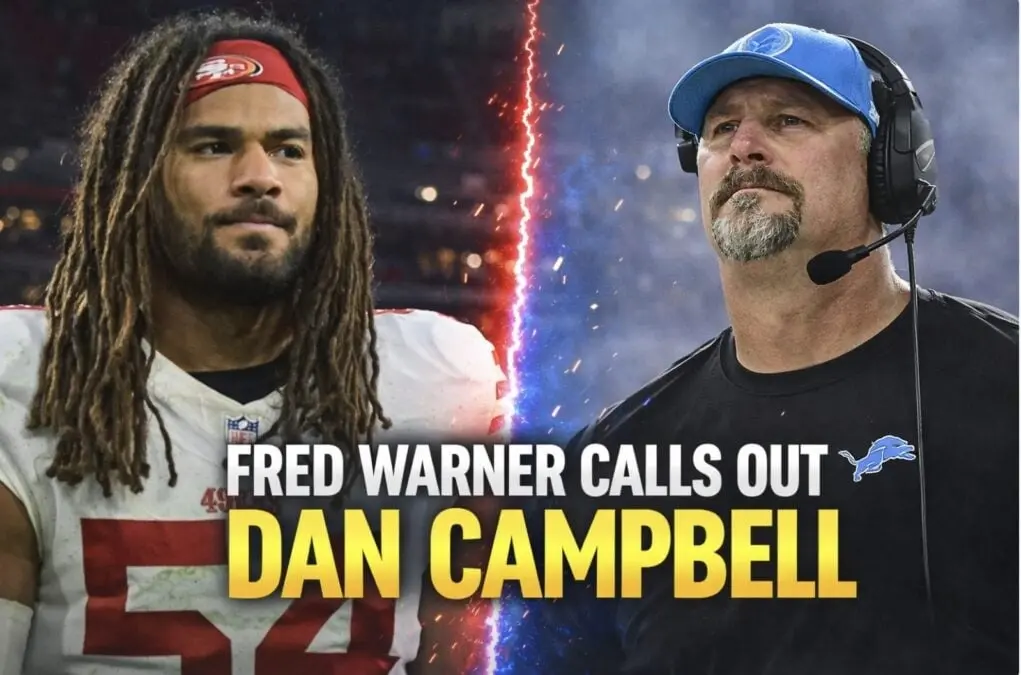
Fred Warner, one of the NFL’s smartest and most respected defensive leaders, didn’t call out Campbell by name in an aggressive rant. Instead, he made a calculated remark about how teams that pride themselves on extreme physicality often end up paying for it over the course of a season. The implication was clear enough for everyone listening: when you play on the edge every snap, bodies break down faster.
Coming from Warner, the comment carries weight. He is not only a perennial All-Pro, but also the centerpiece of a 49ers defense that prides itself on balance—physical, yes, but also disciplined and efficient. San Francisco has had its own injury struggles in recent years, yet Warner himself has been remarkably durable, a testament to preparation, conditioning, and, some would argue, a smarter approach to managing physical stress.
So does Warner make a good point? In purely football terms, there is evidence to support his argument. The Lions’ injury report has grown uncomfortably long, affecting key contributors on both sides of the ball. When starters and rotational players are consistently unavailable, even the most resilient team identity can start to crack. Aggression, when unchecked, can lead to unnecessary wear and tear, especially in a 17-game regular season followed by the postseason.
However, focusing solely on Campbell’s philosophy risks oversimplifying a complex issue. Injuries in the NFL are rarely caused by one factor alone. Bad luck, playing surface, depth, travel, and even random collisions all play significant roles. Plenty of teams with conservative reputations suffer devastating injury waves, while some hyper-physical squads make it through relatively intact. Football, at its core, is violent by nature, regardless of coaching style.
Supporters of Campbell are quick to point out that Detroit’s physical approach is not reckless. The Lions emphasize fundamentals, proper tackling technique, and conditioning. They do not lead the league in penalties for late hits or personal fouls, which would suggest uncontrolled aggression. Instead, their intensity is emotional and cultural, not necessarily rooted in unsafe play.
There is also the question of credibility and timing. Warner’s comments come in the context of potential postseason matchups and ongoing rivalry between NFC contenders. In that sense, the remark could be interpreted as psychological gamesmanship, a subtle attempt to frame Detroit as a team that might not hold up physically when it matters most. That does not invalidate the point, but it does complicate the motivation behind it.
From another perspective, Warner may simply be offering a veteran’s insight. As a linebacker who has seen seasons derailed by injuries across the league, he understands the fine line between toughness and sustainability. His words can be read not as mockery, but as a cautionary observation rooted in experience. If so, the criticism is less personal and more philosophical.
Dan Campbell, for his part, is unlikely to change who he is. His authenticity is central to why players believe in him. Asking Campbell to dial back his edge would be like asking the Lions to abandon the very identity that lifted them out of irrelevance. In Detroit’s view, injuries are a price worth paying if the alternative is returning to a passive, losing culture.
Ultimately, whether Fred Warner makes a good point depends on what lens you use. From a medical and longevity standpoint, there is truth in questioning whether constant emotional and physical intensity can be maintained without consequence. From a competitive standpoint, however, Campbell’s approach has produced tangible results, including a tougher roster and a team that no longer folds under pressure.
What this exchange really highlights is the contrast between two successful philosophies. San Francisco represents calculated dominance, blending physicality with restraint. Detroit represents emotional transformation, fueled by raw intensity and belief. Both can win. Both carry risks.
In the end, the debate will not be settled by comments or counter-comments, but on the field. If the Lions overcome their injuries and continue to thrive, Campbell’s philosophy will look validated. If they falter as bodies fail, Warner’s words will echo louder in hindsight. For now, it stands as one of the more thought-provoking moments of NFL discourse this season, reminding everyone that in football, how you play can matter just as much as how hard you play.