THE MOST UNIQUE AND BIZARRE CASE IN THE HISTORY OF WORLD HORSE RACING: Jockey Frank Hayes had never won a race before. While leading on his horse Sweet Kiss, he suddenly suffered a severe heart attack and died on horseback. Strangely, his body remained firmly on the horse’s back until Sweet Kiss crossed the finish line first. The referee declared the result valid, making Frank Hayes the only person in history to win a race after… death. However, Sweet Kiss was later nicknamed “The Kiss of Death,” and no one dared ride it again.
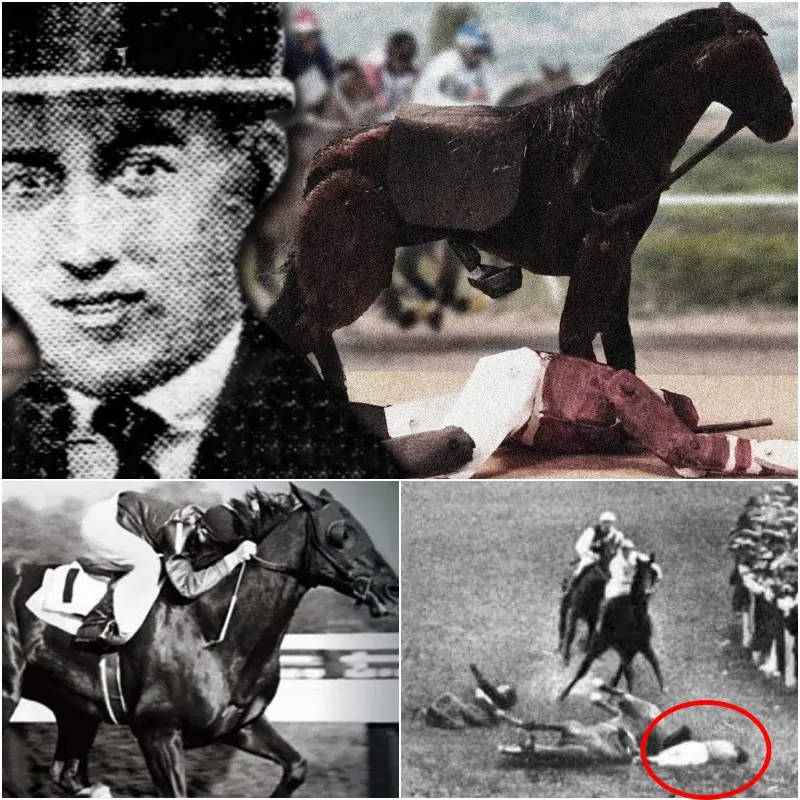
On a warm afternoon of June 4, 1923, at the prestigious Belmont Park racetrack in Elmont, New York, one of the most extraordinary and macabre events in the annals of horse racing unfolded. The venue, known for hosting some of the sport’s most prestigious events including the Belmont Stakes, was the stage for a routine steeplechase race over two miles with twelve formidable fences. Among the entrants was a longshot named Sweet Kiss, a seven-year-old chestnut mare owned by Miss A. M. Frayling. At odds of 20-1, few bettors gave her much chance of victory.
What made the entry particularly unusual was the jockey: Frank Hayes, a 22-year-old Irish immigrant who had spent his career primarily as a trainer and stableman rather than a professional rider.
Hayes had never won a race in his life. By profession, he was not accustomed to the intense physical demands of jockeying, but his belief in Sweet Kiss’s potential was so strong that he took the extraordinary step of slimming down dramatically to meet the weight requirements. Some accounts suggest this rapid weight loss, combined with the excitement and exertion of the race, may have contributed to the tragedy that followed. Hayes had occasionally ridden in amateur capacities, but this was his chance to prove himself in a professional setting.
The mare’s owner, lacking a regular jockey, entrusted the ride to the enthusiastic young man who knew her best.
As the field of horses lined up and the starter’s flag fell, Sweet Kiss settled into a mid-pack position. The steeplechase demanded not just speed but agility and stamina to clear the jumps safely. Hayes guided his mount with determination, navigating the obstacles one by one. Spectators watched what appeared to be a steadily improving performance from the outsider. Little did they know that something horrific was occurring in the saddle.
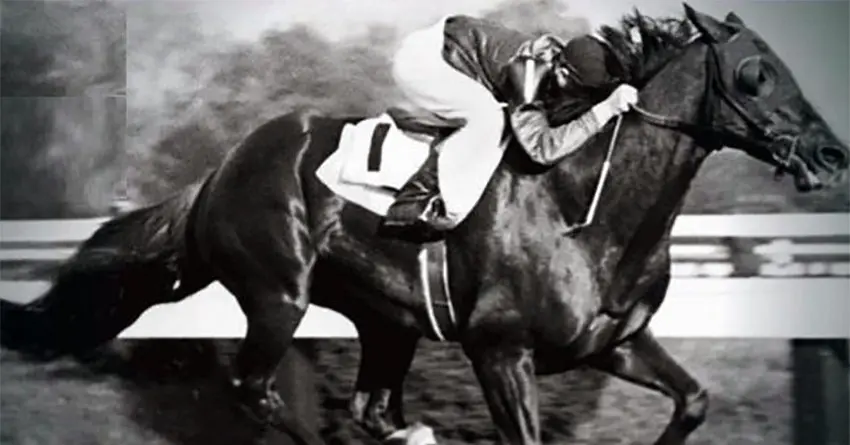
Somewhere in the latter stages of the race—accounts vary on the precise moment, with some placing it near the home turn or approaching the final fences—Frank Hayes suffered a massive heart attack. The sudden cardiac event claimed his life instantly. Yet, in one of the strangest twists in sporting history, his lifeless body did not fall. Somehow, through a combination of momentum, balance, and perhaps the instinctive grip that remained even in death, Hayes stayed mounted. His form slumped forward, but he remained secure enough for Sweet Kiss to continue her run unimpeded.
The mare, seemingly unaware of the change in her rider, pressed on with the same determination she had shown throughout. As the field approached the final stretch, Sweet Kiss surged ahead. Witnesses later recalled the eerie sight: the jockey hunched over, motionless, while the horse powered toward the wire. When Sweet Kiss crossed the finish line first, winning by a narrow head, the crowd’s initial cheers quickly turned to stunned silence. Officials and onlookers rushed forward, expecting to congratulate the victorious rider. Instead, they discovered Hayes slumped lifeless in the saddle.
Track physician Dr. John E. Voorhees hurried to the scene and pronounced Hayes dead on arrival. The cause was confirmed as a heart attack, likely exacerbated by the physical strain of the race and his recent efforts to shed weight. In a moment that underscored the era’s attitudes toward such incidents, the stewards reviewed the finish and upheld the result. Since Hayes had been astride the horse throughout the race and no rules prohibited such an outcome, Sweet Kiss was declared the official winner.
Frank Hayes thus entered the record books as the only jockey in history to win a race posthumously—a distinction still unmatched nearly a century later and even recognized by Guinness World Records as the first deceased jockey to win a race.
The aftermath was somber. Hayes’s body was removed from the horse, and he was buried three days later at Holy Cross Cemetery in Brooklyn, dressed in his racing silks as a final tribute to his brief moment in the spotlight. For the racing community, the event was both tragic and unforgettable. Newspapers across the country carried the story, blending shock with a sense of dark wonder at the sheer improbability of it all.
Sweet Kiss herself became an unwitting legend. The mare, who had gone from maiden to winner in her only race, never competed again. Traumatized by the incident or perhaps simply retired out of respect and caution, her racing career ended that day with a perfect but haunting record: one start, one victory. Over time, superstition took hold among jockeys and stable hands. The horse earned the grim nickname “Sweet Kiss of Death” or “Sweet Kiss of Death,” a moniker that reflected the fear that riding her might bring similar misfortune.
No jockey dared mount her afterward, and she faded into retirement, her name forever linked to the bizarre triumph and tragedy of that June afternoon.
This singular event stands apart in the long history of horse racing, a sport filled with tales of glory, injury, and occasional heartbreak. While many jockeys have met untimely ends due to falls or accidents, none have achieved victory in the very moment of their passing. The image of a dead man riding to glory, carried across the line by a faithful horse, captures something profoundly human and eerie about the bond between rider and mount. It reminds us that even in a world of calculated risks and high stakes, fate can intervene in the most unexpected ways.
Frank Hayes’s sole victory remains a poignant, if morbid, milestone—one that no other athlete in any sport has replicated. In the end, he died a winner, and the story of that improbable finish continues to fascinate and unsettle racing enthusiasts to this day.