J.K. Rowling Stands Alone: The Only Celebrity Bold Enough to Call Out Transgender Paralympian Valentina Petrillo as a “Cheater”
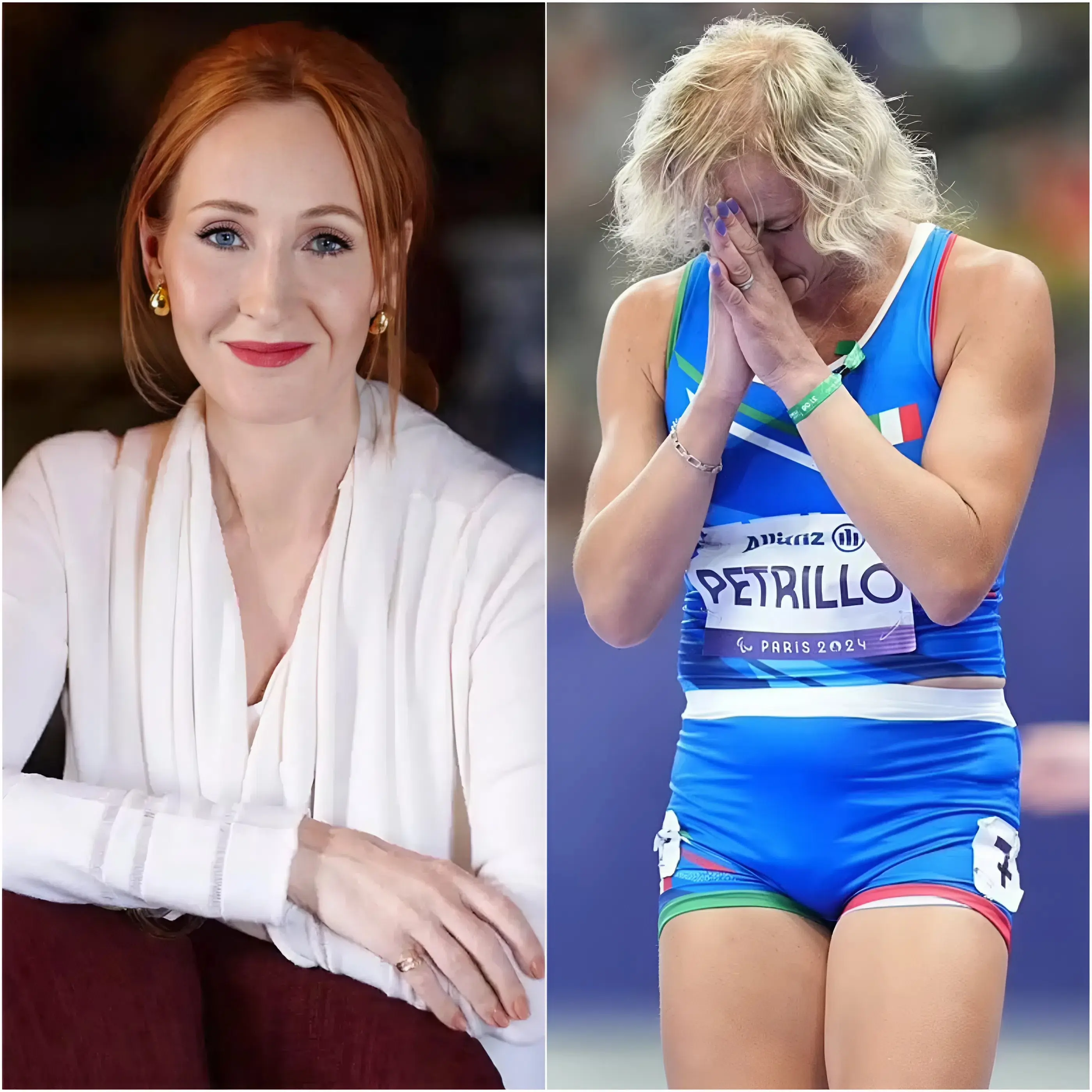
In the wake of the 2024 Paris Paralympics, a firestorm erupted over Italian sprinter Valentina Petrillo, the first openly transgender woman to compete in the women’s category. Petrillo, a 51-year-old visually impaired athlete in the T12 class, qualified for semi-finals in the 200m and 400m events but failed to advance to finals or secure medals. Born male, Petrillo won 11 national titles in the men’s category from 2015 to 2018 before transitioning in 2019 and dominating women’s races thereafter.
Yet, amid widespread media coverage and debates on fairness in women’s sports, only one high-profile celebrity—Harry Potter author J.K. Rowling—publicly condemned Petrillo’s participation as cheating.
Rowling’s outspoken criticism drew parallels to her earlier comments on Algerian boxer Imane Khelif during the Olympics.
The controversy reignited long-standing debates about biological advantages in female athletics, with Rowling emerging as the sole celebrity voice unafraid of backlash.
Valentina Petrillo’s journey to the Paralympics began decades ago. Diagnosed with Stargardt disease at age 14, which severely impairs vision, Petrillo competed successfully in men’s para-athletics for years.
Between 2015 and 2018, as a male athlete, Petrillo claimed 11 Italian national titles in T12 sprint events. After coming out as transgender in 2018 and beginning hormone therapy in 2019, Petrillo switched to the women’s category.
By 2020, she was setting records and winning medals that eluded her in the men’s division.
Critics argue this shift highlights retained male physiological advantages, such as greater muscle mass, bone density, and lung capacity, even after testosterone suppression.
World Para Athletics rules allow transgender women to compete if legally recognized as female and maintaining testosterone below 10 nmol/L for 12 months—a threshold far higher than typical female levels (under 2.4 nmol/L).
In Paris, Petrillo advanced in heats but finished third in semi-finals, posting personal bests without medaling.
She tearfully defended her inclusion as a symbol of progress, stating, “From today, I don’t want to hear anything more about discrimination against transgender people.”
Petrillo later responded to detractors, insisting fellow athletes welcomed her in the Paralympic village.
J.K. Rowling’s scathing response on X (formerly Twitter) thrust the issue into the spotlight. On September 2, 2024, Rowling posted sarcastically: “Why all the anger about the inspirational Petrillo? The cheat community has never had this kind of visibility!
Out and proud cheats like Petrillo prove the era of cheat-shaming is over. What a role model! I say we give Lance Armstrong his medals back and move on.”
She compared Petrillo to doping scandals and linked it to Imane Khelif, whom Rowling had accused of unfair advantage in women’s boxing (despite Khelif not being transgender).
Rowling doubled down, calling Petrillo’s participation a “red line” for disabled women’s sports, emphasizing her own mother’s disability made it personal.
These posts garnered millions of views, amplifying the debate.
Notably, no other A-list celebrities joined Rowling. Former athletes like Sharron Davies and Martina Navratilova criticized the inclusion, but they are retired sports figures, not current Hollywood stars.
High-profile names in entertainment remained silent, perhaps fearing career repercussions in an industry quick to cancel dissenters on transgender issues.
Rowling, already embroiled in lawsuits—including one from Khelif naming her for cyber harassment—stood firm.
Petrillo hit back directly: “JK Rowling is only concerned about the fact that I use the female toilet, but she doesn’t know anything about me.”
She argued only a handful of transgender athletes have ever competed at elite levels, debunking fears of widespread domination.
As of November 2025, no major updates have emerged on Petrillo’s career or new competitions. The 2024 Paralympics remain her pinnacle, with no medals but historic participation.
Rowling’s posts continue circulating on X, often with inflammatory headlines like “I SEE THE WORLD BEING CORRUPTED BY GAYNESS,” though this phrase appears fabricated or satirical in viral memes, not directly from Rowling.
Her actual criticism focused on cheating, not homosexuality.
The broader implications for women’s sports are profound. Organizations like World Athletics ban transgender women from elite female track events if they experienced male puberty, citing irreversible advantages.
Para sports lag behind, prioritizing inclusion over strict fairness checks.

International Paralympic Committee president Andrew Parsons welcomed Petrillo but called for unified, science-based policies.
Petrillo’s case exemplifies the tension: she lost strength post-transition but still outperformed many cisgender women.
Supporters hail her as a trailblazer for visibility; detractors see her as emblematic of eroded female categories.
Rowling’s isolation underscores celebrity culture’s fear of transgender activism. While stars routinely virtue-signal on social issues, few risk the backlash Rowling endures.
She has faced death threats, boycotts, and accusations of transphobia, yet persists.
In a polarized world, her stance resonates with those prioritizing biological reality in sport.
Petrillo, meanwhile, expressed joy in the Paralympic village, feeling “protected” amid external hate.
She hopes her story inspires change, noting rare transgender participation at elite levels.
One year later, the debate simmers without resolution. No new transgender Paralympians have made headlines in 2025, and policies remain fragmented.

Rowling’s voice echoes louder in absence of peers.
This saga highlights a cultural divide: inclusion versus fairness. For biological women in sport, advantages from male puberty—estimated at 10-50% in strength and speed—persist despite hormones.
Petrillo’s pre-transition mediocrity versus post-transition success fuels skepticism.
As sports governing bodies grapple with science, celebrities hide. J.K. Rowling alone dares speak, earning both vilification and admiration.
In defending women’s sports, she has become a lightning rod—and perhaps a hero for the silent majority concerned about fairness.
The world watches as transgender inclusion evolves, but for now, Rowling’s solitary stand defines the conversation.